

the blog.
Non Vegan Ingredients to Avoid
Whether you're a new vegan or a vegan veteran, keeping track of no-no ingredients can be incredibly difficult. Friends and family, from longer term vegans all the way to new vegetarians, have been lamenting hidden animal ingredients popping up all over the place in the foods they used to enjoy with a clean conscience. That's why I'm creating this handy guide! Pin or bookmark it so that you can come back and use it as a reference while shopping, making your life that much easier. These ingredients may be found in food, personal care products, clothing, household products, and more. Remember: no one is perfect and it's impossible to successfully avoid all of these ingredients 100% of the time. Don't beat yourself up or get too caught up in the purity of it all and just do your best!
Whether you're a new vegan or a vegan veteran, keeping track of no-no ingredients can be incredibly difficult. Friends and family, from longer term vegans all the way to new vegetarians, have been lamenting hidden animal ingredients popping up all over the place in the foods they used to enjoy with a clean conscience. That's why I'm creating this handy guide! Pin or bookmark it so that you can come back and use it as a reference while shopping, making your life that much easier. These ingredients may be found in food, personal care products, clothing, household products, and more. Remember: no one is perfect and it's impossible to successfully avoid all of these ingredients 100% of the time. Don't beat yourself up or get too caught up in the purity of it all and just do your best!

A
- Adrenaline - derived from the adrenal glands of pigs, cows, or sheep.
- Albumen/Albumin - derived from eggs.
- Allantoin (also Alcloxa and Aldioxa) - derived from cow urine.
- Alligator Skin
- Alpha-Hydroxy Acids - may be lactic acid, which can be animal derived.
- Ambergris - derived from whale intestines.
- Amino Acids (alanine, - may be animal derived.
- Angora - hair from rabbits or goats.
- Animals Fats and Oils
- Animal Hair
- Arachidonic Acid - derived from the liver, brain, glands, and fat of animals.
- Arachidyl Proprionate - may be derived from animal fat.
B
- Bee Pollen
- Bee Products
- Beeswax
- Beta Carotene - may be derived from animal sources.
- Biotin, Vitamin H, and Vitamin B Factor - found in every living cell, often derived from milk or yeast.
- Blood
- Boar Bristles - boar hair.
- Bone Char - animal bone ash.
- Bone Meal - crushed or ground animal bones.
- Butter, Artificial Butter, Artificial Butter Flavour, Butter Extract, Butter Fat, Butter Flavoured Oil, Butter Solids, Dairy Butter, Natural Butter, Natural Butter Flavour, Whipped Butter
- Buttermilk, Buttermilk Blend, Buttermilk Solids
Related Post: 25 Surprising Non-Vegan Foods
C
- Calfskin
- Caprylamine Oxide, Capryl Betaine, Caprylic Triglyceride and Caprylic Acid - derived from cow's or goat's milk.
- Carmine, Carminic Acid, and Cochineal - derived from crushed female cochineal insects.
- Carotene and Provitamin A - may be derived from animal sources.
- Casein, Caseinate, and Sodium Caseinate - milk protein.
- Cashmere - wool of the Kashmir goat.
- Castor and Castoreum - may be derived from muskrat and beaver genitals. (Synthetics widely used.)
- Catgut - derived from the intestines of sheep, horses, and other animals.
- Cera Flava - derived from bees.
- Cerebrosides - may be derived from the brains of animals.
- Cetyl Alcohol, Cetyl Palmitate - may be derived from sperm whales and dolphins. (Synthetics widely used.)
- Cheese, Cheese Flavour (artificial and natural), Imitation Cheese
- Chitosan - derived from the shells of crustaceans.
- Cholesterol - derived from animal fat, nerve tissue, animal nerve tissue, egg yolks, and blood.
- Civet - derived from a gland near the genitals of civet cats.
- Collagen - usually derived from animal tissue.
- Colours and Dyes - may be of animal origin.
- Confectioner's Glaze - contains approximately 35% shellac (see below).
- Cortisone, Hydrocortisone, and Corticosteroid - may be derived from the adrenal glands of animals. (Synthetics widely used.)
- Cream, Whipped Cream
- Curds
- Custard
- Cysteine, L-Form - may be derived from animal hair.
- Cystine - an amino acid found in urine and horsehair.
D
- Dairy, Dairy Product, Dairy Product Solids
- Down - goose or duck insulating feathers.
- Duodenum Substances - derived from the digestive tracts of cows and pigs.
E
- Eggs
- Egg Protein
- Elastin - derived from the neck ligaments and aortas of cows.
- Emu Oil - derived from factory-farmed emu.
- Estrogen and Estradiol - derived from the urine of a pregnant mare.
F
- Fats and Fatty Acids - derived from animals.
- Feathers - plucked from birds.
- Fish Oil, Fish Liver Oil, and Cod Liver Oil - derived from marine animals.
- Fish Scales
- Fur
G
- Gelatin, Gel, and Hide Glue - protein derived from the skin, tendons, ligaments, and/or bones of cows and pigs.
- Ghee - a form of butter used in Indian cooking
- Glycerin, Glycerol, Glyceryls, Glycreth-26, Polyglycerol, and Glycerides - normally derived from animal fat.
- Guanine - derived from the scales of fish.
H
- Half & Half
- Honey and Honeycomb
- Horsehair
- Hyaluronic Acid - can be derived from umbilical cords and the fluids around the joints of animals.
- Hydrolyzed Animal Protein - derived from animals.
Related Post: 10 Reasons To Go Vegan!
I
- Insulin - derived from hog pancreas.
- Isinglass - a form of gelatine derived from fish bladders.
K
- Kefir - made using milk.
- Keratin - protein derived from ground-up horns, hooves, feather, quills, and hair or animals.
L
- Lactic Acid - can be derived from blood and muscle tissue.
- Lactose, Galactose, Lactate Solids, Lactic Yeast, Lactic Monohydrate, Lactoferrin, Lactoglobulin, Lactulose, Lactalbumin, Lactalbumin Phosphate - derived from the milk of mammals.
- Lanolin, Laneth, Lanogene, Lonolin Acids, Wool Fat, Wool Wax, Lanolin Alcohol, Lanosterols, Isopropyl Lanolate, Cholesterin, Aliphatic Alcohol, and Amerchol L101 - extracted from sheep's wool.
- Lard - fat derived from hog abdomens.
- Leather
- Lecithin and Choline Bitartrate- often obtained from eggs and soybeans.
- Linoleic Acid - an essential fatty acid derived from fatty acids.
- Lipase - derived from the stomachs and tongue glands of calves, kids, and lambs.
- Lipids, Lipoids - derived from animals and plants.
M
- Marine Oil - derived from fish and marine mammals.
- Methionine - usually derived from eggs and milk.
- Milk, Acidophilus Milk, Cultured Milk, Condensed Milk, Dried Milk, Dry Milk Solids (DMS), Evaporated Milk, Lactose-Free Milk, Malted Milk, Milk Derivative, Milk Powder, Milk Protein, Milk Solids, Pasteurized Milk, Powdered Milk, Sour Milk
- Mink Oil - derived from minks.
- Monoglycerides and Diglycerides - derived from animal fat.
- Musk Oil - secretion derived from musk deer, beaver, muskrat, civet cat, and otter genitals.
- Myristic Acid, Myristyls, and Myristal Ether Sulfate - occassionally derived from animals.
N
- Natural Sources - can come from plant or animal sources.
- Nisin, Nisin Preparation - derived from milk.
- Nougat - often contains egg and honey.
- Nucleic Acids - derived from the cells of plants or animals.
O
- Octyl Dodecanol - derived from animal sources.
- Oleic Acid - obtained from animal or vegetable fats.
- Oleyl Alcohol, Ocenol, Oleths, Oleyls - derived from fish.
P
- Palmitic Acid, Palmitamide, Palmitamine, Palmitate - commonly derived from palm oil, but also from animal sources.
- Panthenol, Dexpanthenol, Vitamin B-Complex Factor, Provitamin B-5, Panthenyl - can come from animal, plant, or synthetic sources.
- Pepsin - derived from hog stomachs.
- Placenta - derived from the uterus of dead animals.
- Polypeptides - derived from animal protein.
- Polysorbates - derived from animal fatty acids.
- Pristane - derived from the liver oil of sharks and whales.
- Progesterone - a hormone derived from animals.
- Propolis - derived from beehives.
- Pudding
Q
- Quark - a soft cheese.
R
- Recaldent - derived from milk.
- Rennet, Rennet Casein, Rennin - enzyme derived from calves' stomachs.
- Retinol - vitamin A derived from animals.
- RNA (Ribonucleic Acid) - can be derived from animal or plant cells.
- Royal Jelly - a secretion from the throat glands of bees.
Related Post: 15 Weird Things I Do Now That I'm Vegan
S
- Sable Brushes - made from the fur of sables (similar to weasels).
- Shark Liver Oil and Squalane - derived from sharks.
- Sheepskin
- Shellac and Resinous Glaze - derived from insect excretions.
- Silk and Silk Powder - obtained from silk worms.
- Snails
- Sour Cream, Sour Cream Solids, Imitation Sour Cream
- Sperm Oil and Spermaceti - mostly derived from petroleum, but also derived from the heads of sperm whales and dolphins.
- Sponge - a plant-like marine animal.
- Stearic Acid, Stearamide, Stearamine, Stearamine Oxide, Stearates, Stearic Hydrazide, Stearone, Stearoxytrimethylsilane, Stearoyl Lactylic Acid, Stearyl Acetate, Dimethyl Stearamine and Isopropyl Palmitate - can be derived from cows, pigs, sheep, and cats and dogs euthanized in animal shelters.
- Stearyl Alcohol, Sterols, Stearyl Caprylate, etc. - may be prepared from sperm whale oil.
- Steroids and Sterols - can be derived from animal glands or plant sources.
- Suede
- Sugar - often refined using bone char
T
- Tallow, Tallow Fatty Alcohol, Sodium Tallowate, Tallow Acid, etc. - rendered beef fat.
- Turtle Oil and Sea Turtle Oil - derived from the muscles and genitals of giant sea turtles.
- Tyrosine - can be derived from milk.
U
- Urea, Uric Acid - typically synthetic, can be derived from the urine of animals and other bodily fluids.
V
- Vitamin A - can come from fish liver oil, egg yolk, butter, and plant and synthetic sources.
- Vitamin B12 - can come from animal products or bacteria cultures.
- Vitamin D, Provitamin D-2, Ergocalciferol, Ergosterol, Vitamin D2, Calciferol, Vitamin D3 - can be derived from animal or plant sources.
W
- Wax - derived from both animal and plant sources.
- Whey, Acid Whey, Cured Whey, Delactosed Whey, Demineralized Whey, Hydrolyzed Whey, Powdered Whey, Reduced Mineral Whey, Sweet Dairy Whey, Whey Protein, Whey Protein Concentrate, Whey Powder, Whey Solids - a serum from milk.
- Wool - derived from sheep.
Y
- Yogurt
Notice something I missed? Let me know in the comments and I'll add it! I will continue to update this post as I find new ingredients that are animal-derived so that we can all work on making our lives as animal-product free as possible, together!
Until next time,












How To Build A Capsule Wardrobe
Have you ever woken up, looked at your closet full to bursting and thought: "I have absolutely nothing to wear."? Me too. How is it that you can own so many pieces and still feel this way? Maybe you're like me, surrounding yourself with mediocre pieces and wearing your few favourites over and over again while avoiding the rest. Well, enough is enough! I am finally creating a capsule wardrobe and I couldn't be more excited to share my journey with you. Read on to learn how you can create the perfect, concise, wardrobe for you; full of clothing you love and want to wear every single day!
Have you ever woken up, looked at your closet full to bursting and thought: "I have absolutely nothing to wear."? Me too. How is it that you can own so many pieces and still feel this way? Maybe you're like me, surrounding yourself with mediocre pieces and wearing your few favourites over and over again while avoiding the rest. Well, enough is enough! I am finally creating a capsule wardrobe and I couldn't be more excited to share my journey with you (and hopefully inspire you to follow suit). Read on to learn how you can create the perfect, concise, wardrobe; full of clothing you love and want to wear every single day!
What is a capsule wardrobe?
A capsule wardrobe is a small, intentional, daily wardrobe made up of pieces you love, fit you and your lifestyle, and all work together. For me it is comprised of 40 pieces (but you can pick whatever number works for you!) including tops, bottoms, dresses, rompers, shoes and outerwear. It does not include workout clothing, audition and special occasion wear, accessories, and loungewear for around the house. A capsule wardrobe is intended for a specific season (like fall) and is worn for 3 months, without any new clothing purchases!
The idea behind a capsule wardrobe is to...
- Simplify your life.
- Reduce the amount of time spent deciding what to wear and increase the time available for doing the things you truly love.
- Cut down on spending and get the full value out of your clothes.
- Find your style and revel in it.
Sound good? Then keep reading to learn how to create yours!
How to create a capsule wardrobe of your own.
ONE Get inspired.
Head over to your style board on Pinterest (I know you have one!) and take a look at the pins. Is there a style that sticks out at you? Which are your favourite looks? What pieces show up again and again? As you scroll through and analyze you will begin to get a sense of what your style aesthetic is. It may be far from how you dress right now, or look exactly like your current wardrobe. Either way, this is the style you're drawn to and what you should base your capsule wardrobe on, just so long as it fits your lifestyle! You could even start a new board and pin all of your absolute favourite that fit the season you're working on to have all of your inspiration in one, easy to find, place.
Don't have a style board? Feel free to look through mine!
Also feel free to take a look at my Fall and Winter capsule wardrobes!
TWO Come up with 3 words that describe your style.
Or five, or twelve. The number of words isn't important. What is important is that you can describe your ideal style in a clear and concise way. This will only help you as you build your capsule! Try looking at the list below for some inspiration:
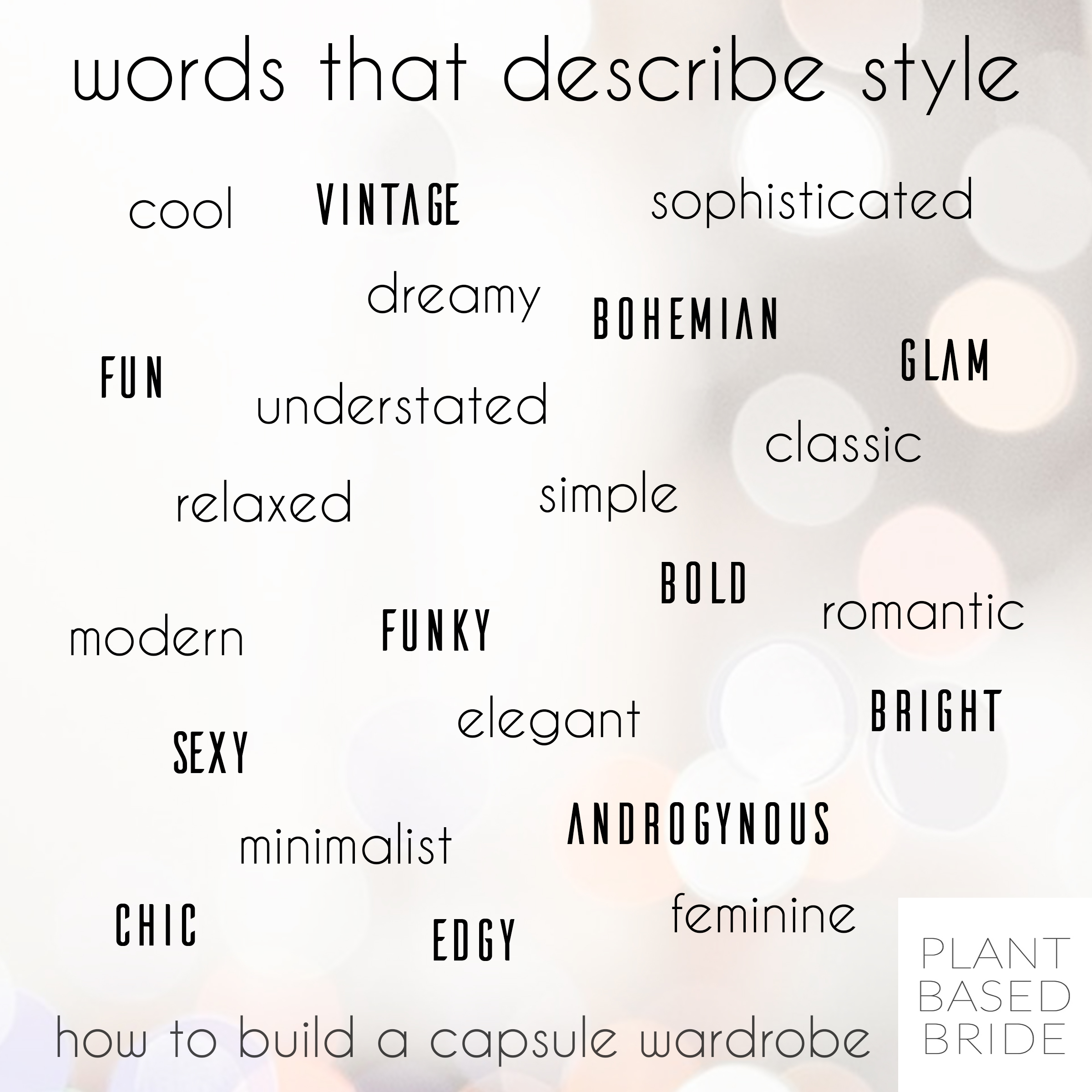
Now get out a pen and some paper and write down the words that describe your dream (yet practical) style. Seriously, do it!
THREE 'Tis the season.
Think about the season you're building your wardrobe for. Is it winter in Canada? Then you probably won't need any shorts. Think about temperatures, weather like rain or snow, and the colours that you like to wear during that season. Keep these things in mind as you choose your pieces!
FOUR Pick a number.
Next you want to pick your number of pieces. I decided to go with 40. This breaks down to:
- 17 tops;
- 9 bottoms;
- 3 dresses and rompers;
- 7 pairs of shoes, and;
- 4 pieces of outerwear.
Your numbers don't have to be the same as mine, and they may change slightly as you go, but I find it really helps to have a structure to work in while selecting your pieces.
FIVE Go through your wardrobe.
Now it's time to go through the clothes you already own and make 5 piles:
- Capsule (love it, in season);
- Seasonal (love it, out of season);
- Maybe (unsure due to style, fit, cost, etc.);
- Donate or Sell (don't love it or wear it), and;
- Trash (too worn to be donated).
Go ahead and throw out your trash pile, separate your donate and sell pile, and store your seasonal clothing in a box under the bed or in a closet. Then, collect your capsule pile and write down what you have by category. How many items do you have? What are you missing? Is there something you need for your capsule hiding in your maybe pile that could do the trick? If not, add the item to your shopping list.


Need more help sorting through your clothes? Check out Marie Kondo's book on decluttering your life! (Click on the book cover to buy it on Amazon! This is an affiliate link.)
SIX Plan your capsule.
As you go through your items think about the overall cohesiveness of your wardrobe. The aim is to have items that work with as many other pieces in your wardrobe as possible. This can be achieved through colour palette or style. I like to keep the majority of my wardrobe neutral, consisting of black and white, to allow for easier mix and matching. Analyze your items for holes: is there a sweater you need to pull together multiple outfits? What about a pair of shoes that would make that dress and those jeans really pop? Continue adding to your shopping list until you reach your golden number and have each piece you need to make your wardrobe work. This step requires a bit of shuffling around to find the perfect combination of items that gives you the most bang (and outfits) for your buck!
SEVEN Shop.
Once you're happy with your list, it's time to shop! Make a budget before you go to ensure well thought out purchases. You're looking for items that are high quality, fit well, and radiate the style you're going for with your capsule. Bring inspiration images with you and remind yourself of your style words each time you pick up an item. Does it say what you want it to say? Will it merge seamlessly with the wardrobe you're building? Will it last through repeated wear for at least the next 3 months?
EIGHT Wear.
Hang up your capsule wardrobe and get the rest of your clothing out of sight. You will feel a calmness descend over you (I guarantee it!). Welcome to your new life! Now comes the fun part: styling outfits! You can take photos of the items you chose for reference or to upload to apps like stylebook to help with outfit building, or just wing it. You can also take photos of each outfit you build to keep track of the ones you really love for reference as you build next season's wardrobe. Enjoy your pieces for the next 3 months, then start planning for capsule #2 in the last couple weeks of the third month.
Be sure to check back to see my fall capsule wardrobe on the blog next week!
Until next time,

How do you feel about capsule wardrobes? Would you ever try one?
Don't forget to subscribe to the plant based bride newsletter to get my fall capsule wardrobe post delivered right to your inbox! (Form at the bottom of this page)







15 Weird Things I Do Now That I'm Vegan
In the interest of transparency, I feel it's important to mention that I've always been weird. This isn't some kind of new thing. Just ask Jason. I'm an introvert, but when you get to know me well? All bets are off! I'm an incredibly opinionated and creative person, and like what I like no matter how "weird" or "nerdy" other people may think those things are. I make big expressive faces and voices, love to sing all day long, and love Doctor Who. And while it may seem that there isn't much room for more weirdness from there, I definitely got weirder when I went vegan. Much weirder. Keep reading as I confess all and tell you the 15 weird things that I've started doing since going vegan!
I got the idea for this post from Matt Frazier of No Meat Athlete on his podcast. Check it out here!

In the interest of transparency, I feel it's important to mention that I've always been weird. This isn't some kind of new thing. Just ask Jason. I'm an introvert, but when you get to know me well? All bets are off! I'm an incredibly opinionated and creative person, and like what I like no matter how "weird" or "nerdy" other people may think those things are. I make big expressive faces and voices, love to sing all day long, and love Doctor Who. And while it may seem that there isn't much room for more weirdness from there, I definitely got weirder when I went vegan. Much weirder. Keep reading as I confess all and tell you the 15 weird things that I've started doing since going vegan!
ONE I sometimes go an entire day only eating bananas.
Not only that, but I like 'em good and spotty.
TWO I read the ingredient list on everything. Twice.
Food? I read the ingredient list. Toothpaste? I read the ingredient list. Clothes? I read the materials list. All day long, every day.
THREE I spend exorbitant amounts of time reading books, watching documentaries, listening to podcasts, and watching you tube videos about veganism, nutrition, animal rights, and the environment.
I am on a constant hunt for more information about the vegan lifestyle and the state of our planet. All of my curiosity and interest that was fostered in school has been transferred to this one, infinitely fascinating, interrelated group of subjects.
FOUR I eat sriracha on everything.
Mushrooms, rice cakes, pita bread, rice, pasta, tofu scramble, salad... you name it, I'll sriracha it.
FIVE I love tempeh, tofu, and seitan.
And other things that make my parents go "Huh?"
SIX I eat huge portions, especially of fruit and salad!
That family size salad bowl? I'll have two, thanks. One apple for breakfast? Uh... no. How about 5.
SEVEN I cross the street to avoid shops with meat in the window.
And I don't shop at grocery stores with lots of animal flesh on display. It's gross and upsetting and smells horrific.
EIGHT I bring food with me pretty much everywhere.
Tupperware full of beans and rice? Check. A bunch of bananas? Check. Rice cakes and a mini bottle of sriracha? Double check!
NINE I love green smoothies with odd ingredients!
The more gross it sounds to the average Joe, the more I want it in my belly.
TEN I can order off the average menu in less than a minute, but it takes me forever to decide at a vegan restaurant.
What? I have more than one option that needs to be modified by removing half of the ingredients to be vegan? This is going to take a while...
*30 minutes later*
I'll get the Tempeh Quinoa bowl. Wait! No, the Mushroom Risotto. But what about the soup!
*another 20 minutes later*
IDON'TKNOW...AHH...How do normal people do this everyday??
ELEVEN I love salad without salad dressing.
Give me all them raw, plain veggies!
TWELVE I can talk about veganism for hours and hours and still have more to say.
And that's why I started this blog. (Duh.)
THIRTEEN I've become a bit of a hermit.
I avoid situations in which I'll be around lots of animal products. It's hard to have fun when you're surrounded by dead flesh. Or is that just me?
FOURTEEN I use coconut oil for everything.
It's figuratively a miracle!
FIFTEEN I dislike almost all junk food.
Seriously. All I want is fresh produce all day everyday.
And there you have it. The 15 ways I'm weirder than I was two and a half years ago. And that's really saying something!
Until next time,

What weird things did you start doing when you went vegan? I want to hear them all! Write to me in the comments below or on social media.
Don't forget to subscribe to the plant based bride newsletter at the bottom of this page. It's fun!
Living With Less: A Review of The Life-Changing Magic of Tidying Up & How To Declutter the KonMari Way!
Hello and welcome to instalment number one of my Living With Less series! Today I’m tackling the first step in anyone’s minimalism journey, decluttering, with the help of the KonMari method. This method was developed by Marie Kondo, author of The Life-Changing Magic of Tidying Up and an absolute genius. I’m going to give you a summary and review of the book and outline the simple steps you can take to rid your life of clutter for good!
Hello and welcome to instalment number one of my Living With Less series! Today I’m tackling the first step in anyone’s minimalism journey, decluttering, with the help of the KonMari method. This method was developed by Marie Kondo, author of The Life-Changing Magic of Tidying Up (and an absolute genius.) I’m going to give you a summary and review of the book and outline the simple steps you can take to rid your life of clutter for good!
(This post contains affiliate links.)
Marie Kondo is an organizing consultant and author from Japan. She has a wonderful no-nonsense approach that really appeals to me, and is extremely likeable. Marie explains why most people are suffering under the weight of their belongings and how to free yourself from clutter. The book is easy to read and understand, and incredibly engaging. I read it from cover to cover in a couple of days and was immediately itching to declutter! This book is such an inspiring read; I’m not surprised that it’s amassed such a large following!
The book begins by shedding light on the common problems with organizing and decluttering that the majority of us share. She then goes on to explain her method of organization and why it works. Next comes an in depth guide to decluttering your home from top to bottom and storing those precious items you decide to keep.


Marie's method is a breath of fresh air which focuses on the joy special possessions can bring rather than the need for acquisition or holding on to useless items "just in case". She demands perfection, which is kind of wonderful in a world full of unnecessary moderation, yet understands that her clients and her readers are only human, and that some things just mean so much to us on a sentimental level that they belong in our lives. She also believes that tidying should happen only once, not everyday. This is wonderful news for all of us busy people who want to do it all at once and be done for good!
I really enjoyed this book and would recommend it to absolutely anyone. Click on the book cover to buy it on amazon and get started on your minimalism journey with me! (Friendly Disclaimer: This is an affiliate link. There is no extra cost for you, but the small commission I receive if you purchase through my link helps me keep this site up and running!)
Read on to learn how to declutter using the the KonMari method!
How To Declutter Your Life, the KonMari Way!
ONE Dress up for the event. One of Marie's main beliefs is that tidying should be a special event, not a daily chore. And don't we usually dress up for special events? Don't do all of your tidying in sweatpants; through on a smart blazer or a pretty dress and give tidying the respect it deserves!
TWO Tidy all at once. I'll say it again, just because it's such a revolutionary thought! Marie asserts that tidying should be a one time event not a daily chore! Clear your schedule so that you can do it once and do it right.
THREE Discard by category, not location. Don't tidy your kitchen, then the bedroom, and so on. Marie has learned the optimal method of decluttering from trial and error and her extensive experience. Go category by category, and in the order she outlines in the book:
- Clothing;
- Books;
- Papers;
- Miscellaneous items, and;
- Sentimental items.
FOUR Put everything on the floor. One category at a time, go around the house and grab every item then put it in one big pile on the floor. Not only does this ensure that you don't forget or miss anything, but it shows you just how much you actually own; a pretty sobering realization!
FIVE Hold each and every item. Pick up each belonging, one at a time, and ask yourself "Does this spark joy?" If yes, keep it. If not, put it in the donate or sell pile!
SIX Focus. Don't play music or watch TV while you sort. This is an important task that deserves 100% of your focus!
SEVEN Discard all, then organize. Resist the urge to put things away as you go. Marie says it's important to go through each category and discard before organizing what you've decided to keep.
EIGHT Thank your belongings for their service. This one can seem a bit bizarre, but is quite nice when you think about it. Marie suggests that you take a moment to thank the items you are discarding for their service. Even if you are only thanking them for teaching you what you don't like, she says you should find a reason to be thankful for the time they spent in your possession.
This is just a summary of Marie's advice. Go read the book to get the full benefit of her method and to hear all of the principles right from the horse's mouth!
I hope I've inspired at least one of you to explore the KonMari method and bring it into your life. It has only been a month and a bit since I applied these principles in my own home, and while I'm still a bit of a work in progress, I'm noticing incredible benefits! Remember that I will be posting a new Living with Less post each and every Tuesday for the foreseeable future. Don't forget to check in on the blog every week or subscribe to the Plant Based Bride newsletter (you'll find the form at the bottom of this page) for updates right to your inbox!
Until next time,

Have you read Marie's book? I'd love to hear your review in the comments below!
Linked Up!
Coined by Elizabeth Jean @xparmesanprincessx, the personal curriculum trend is about creating a self-directed learning plan focused on areas of personal interest, loosely based on a school curriculum structure, including things like assigned reading, goals, assignments, and final projects.
At its core, the personal curriculum movement is about celebrating lifelong learning and intellectual curiosity. It's about being more intentional about how we spend our time when we're not sleeping, or at work, or doing the basic maintenance or admin or chores to keep our lives going. It's about using our free time to enrich our lives in a way that is purposeful and intentional and joyful, indulging our curiosity as adults, even once we're outside of structured school environments, getting excited about learning and allowing ourselves the freedom to go down those rabbit holes in our special interests, to challenge our brains in ways that we maybe don't get the chance to in our day-to-day lives.