

the blog.
Should You Get Rid Of All Your Leather Now That You're Vegan?
"What should a vegan do with all of their leather, wool, silk, and down products?"
If you asked 100 vegans you would hear 100 different opinions, but I believe there is no right or wrong answer to this question. This is not, unfortunately, a black and white issue. Ridding your life of animal products for good can be a long process or even impossible in today's world. The way they are used in just about everything, whether or not they need to be, makes transitioning to a fully vegan lifestyle a struggle. Do you drive a car or take the bus? Do you own a computer? Do you watch movies on film? You're using animal products. In today's world, the prevalence of objects containing animal products is staggering. So what should you do?
"What should a vegan do with all of their leather, wool, silk, and down products?"
If you asked 100 vegans you would hear 100 different opinions, but I believe there is no right or wrong answer to this question. This is not, unfortunately, a black and white issue. Ridding your life of animal products for good can be a long process or even impossible in today's world. The way they are used in just about everything, whether or not they need to be, makes transitioning to a fully vegan lifestyle a struggle. Do you drive a car or take the bus? Do you own a computer? Do you watch movies on film? You're using animal products. In today's world, the prevalence of objects containing animal products is staggering. So what should you do?
Two Sides of the Vegan Coin
From my observations there seem to be two different kinds of ethical vegan: those who believe animals should never be thought of in terms of the objects they can be made into ("Purity" Vegans), and those who don't believe animals should be made to suffer, but think that animals treated with love and respect may be used to create objects for human use when they die, whether of natural causes or by a compassionate human hand ("Impact" Vegans)*. Purity Vegans are the ones you meet who would have disposed of all items containing animal bi-products immediately upon deciding to go vegan, without debate. They are also the ones who are (usually) more likely to judge other vegans for wearing or using items containing animal products. Impact Vegans, who tend to believe that contributing to further animal suffering is the real issue, may wear and use these products until they wear out and even purchase new goods containing animal products, as long as they are second hand.
So which kind of vegan is right?
I can't give you a definitive answer. Personally, I sit somewhere in the middle. I believe that ethical veganism is about witholding your consumer dollars from the numerous industries that exploit and torture sentient beings. Under this definition, what you do with previously purchased items isn't the most important issue at hand. There is definitely a big part of me that is uncomfortable with wearing shoes made of leather or a coat with down filling, but the majority of that uneasiness comes from the knowledge that the animals suffered horribly to make these garments possible, not from the fact that they were used to create garments in the first place. Humans have been using skins and all other animal bi-products from a hunt for various purposes for thousands of years, and I don't see anything particularly wrong with that. It is the nature of life for one being to kill another and use it to sustain its life. What I have a problem with is the way that we, as a culture, now treat animals as commodoties and materials and not living beings. That we give them no respect and brutalize them for our own benefit. This is why, while I am wholeheartedly against buying new items containing animal bi-products if I can at all avoid it, I am not 100% against using products that were previously owned, whether I was the original buyer or not. These products have already been consumed and done their damage. Continuing to use them does not feed into the consumer/animal suffering loop.
Let's Look at an Example
Let's look at a hypothetical argument between a purity (in italics) and an impact vegan. (I'm going to use leather boots as an example for simplicity's sake).
Why are you wearing leather boots? I thought you were vegan?
I am vegan. I purchased these boots before I knew what animals went through for their production.
But now you know. How could you still wear them?
Yes, I do. But in continuing to wear these shoes I'm not causing any additional suffering on top of what I already have.
Yes you are! You're supporting the leather industry!
I have supported the leather industry in the past, but I no longer purchase new leather products. The animals that have died to provide these shoes have already suffered and been killed. I am not causing them, nor other animals, any harm by continuing to wear these shoes. Let me explain the normal consumer and animal suffering cycle in the leather industry**:

But if I wear boots I've already purchased? No new animal suffering. Even if I purchase a new-to-me pair of leather boots at a thrift store, there isn't the same impact. Just say someone donates her old pair of leather dress boots to a thrift shop.
- I drop in and buy them for $30.
- The owner takes that $30 and uses it to pay his/her expenses.
That's it. No distributor calls a manfacturer who orders more leather, causing an animal to be slaughtered. When the shelf in the thrift store is empty there isn't the same chain of events as in a regular shop. The thrift store owner simply waits for more donations or purchases old goods off of patrons to replace the boots I bought. In this case, I have contributed $0 to animal suffering.
But you're a walking billboard! People will see you wearing leather and think it's ok or be inspired to buy leather shoes!
There is leather everywhere. It is so commonly accepted in our culture that no one sees it for what it really is anymore. My wearing or not wearing leather boots has about as much bearing as a fly landing on someone's leg on their decision whether or not to buy leather over some other material.
But then you're still contributing to a culture with leather everywhere! You should only wear vegan products.
Ok, say I wear vegan boots instead of leather boots but that they APPEAR to be leather. How is that any different to someone just passing me on the street? The vegan boots did not cause suffering, but strangers don't know that. And if I threw out my old boots to buy new vegan ones I'm disrespecting the sacrifice made by the animal to create them and being wasteful by requiring more ressources to be used up for the sake of my feet, even if they aren't resources that cause suffering to animals. And what if those vegan boots are made of synthetic materials that are bad for the environment? Or in manufacturing plants that treat their human workers inhumanely? While animal cruelty is a very important issue in our society that needs to be addressed, it is not the sole issue.
You can't waste something that isn't a resource, and animals and their bodies are not resources.
Perhaps they shouldn't be, but in our culture they are. And they have been for thousands of years. I believe that an animal allowed to live a full and hapy life, treated with love and respect, can contribute to the well being of another species after their death without causing an ethical dilemma. I think of it in similar terms to a human donating organs or their bodies for research and medicine after death. I realize that an animal can't make the conscious decision to donate the use of their bodies to humans after death, but when they are no longer alive they are no longer in need of their bodies. It is the way of the natural world to use the resources at our disposal to extend our lives. The difference between current day humans and every other species is that we intentionally brutalize other beings for our purposes in a way that no other species on earth does. We choose to ignore the sentience of other living creatures to ease our collective conscience rather than choosing the ethical and compassionate route of treating them with the respect and kindness they deserve.
As you can see, this is a very complicated issue.
So, how do you decide what to do?
I believe that everyone has to make the decision for themselves. You have to look into your heart and your mind to decide what you're comfortable with and then stick to your decision, no matter what criticism may come your way from vegans and non-vegans alike. For me that means donating, selling, and giving away the majority of my belongings containing animal products and using the rest until they wear out or I can afford vegan replacements. I am a 22 year old saving for my wedding and don't have a lot of extra cash sitting around, so this is the best strategy for me.
You can keep any non-vegan products for wearing at home only, until they wear out, so as not to "promote" the use of leather products, if that is something that worries you. You can sell, donate, or give away every single non-vegan item you own. You can keep every single item containing animal-products and use them until they fall apart. You can pick and choose from all four.
My one plea is to please, please, not throw out your products containing animal products that still can be used. The animals who suffered for their manufacture deserve much more than sitting in a landfill.
And if someone asks you why you're wearing leather boots? Use it as a conversation starter to talk about banding together to demand more ethical treatment of animals. Don't get defensive, be open, and watch how disarming it can be!
Until next time...
This is a very complicated issue and I would love to hear your opinion in the comments below! What did you do with your non-vegan belongings when you made the switch? How do you feel about wearing animal products, even if they're second hand?
Also, be sure to use the sign up form at the bottom of the page to get updates from me and new blog posts right to your inbox!
*Thank you Ben Davidow for the awesome terminology of purity/impact vegans!
**Thank you carpevegan.com for the inspiration to make the infographic! I found your article on thrift store leather very interesting.



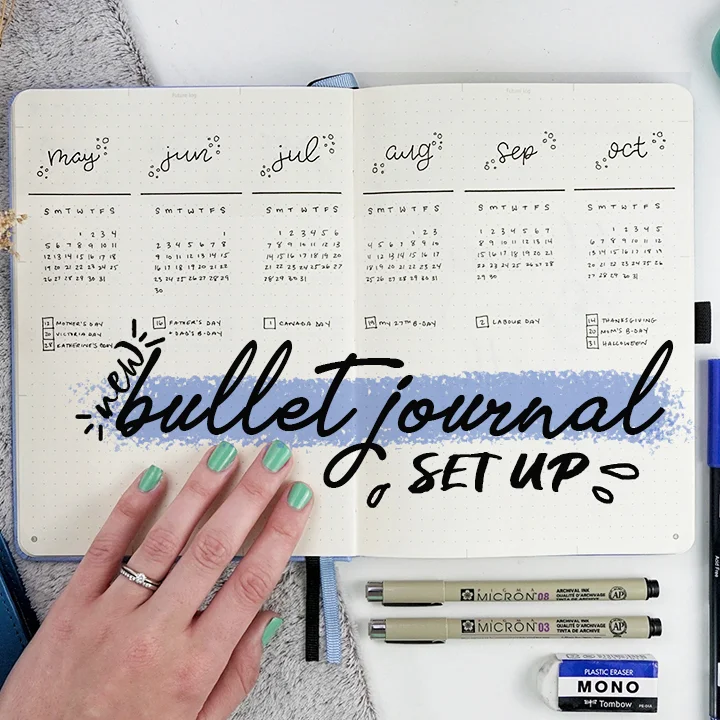




How to Use a Bullet Journal to Stay Organized!
I have always loved organization and have used a daily planner for years. Recently I came across the "bullet journal" approach, which I have absolutely loved! I wanted to share what I do with all of you in case it works for you as well as it has been working for me!
I have always enjoyed organization, since a very young age. I LOVED back to school shopping, not so much for the clothes, but for the trip to Staples where I could buy new notebooks, binders, dividers, pencils, pens, highlighters, scissors, staplers, and so, SO, much more. (Sorry Mom and Dad). As early as elementary school I used bullet points and headings, highlighted, and colour coded my notes. Everything in its place, and all that.
All of this early school organization carried on into my adult life in the form of (surprise, surprise) a daily planner. Over the years my daily planner has taken many forms, but in recently it has been a small pocket notebook with each day's to do list and appointments. While I like this format, and am now using something relatively similar, I had trouble distinguishing between different types of tasks and items and organizing tasks that didn't get done. I did some research into how other people organize their daily planners and came across the "bullet journal" approach, which immediately intrigued me. It was created by Ryder Carroll and is a pretty cool system! I started my own trial and have absolutely loved it. I wanted to share my variation with all of you in case it works for you as well as it has been working for me!
What is a Bullet Journal?
Basically, a bullet journal is an organizational system that you can use in your to do lists, notebooks or daily planners to speed up the time it takes you to make an entry and find what you're looking for.
Creating a Key
A key is used to remember the symbols you choose to use to make your journal faster to write and easier to read. I wrote my key on a post-it note so that I could move it from page to page as a reference, but many simply write it on the first page of their notebook. Some parts of my key I use daily, while others I only use from time to time. I haven't implemented this system fully into all of my general notebooks, but when I do I'm sure the other symbols will come in quite handy!
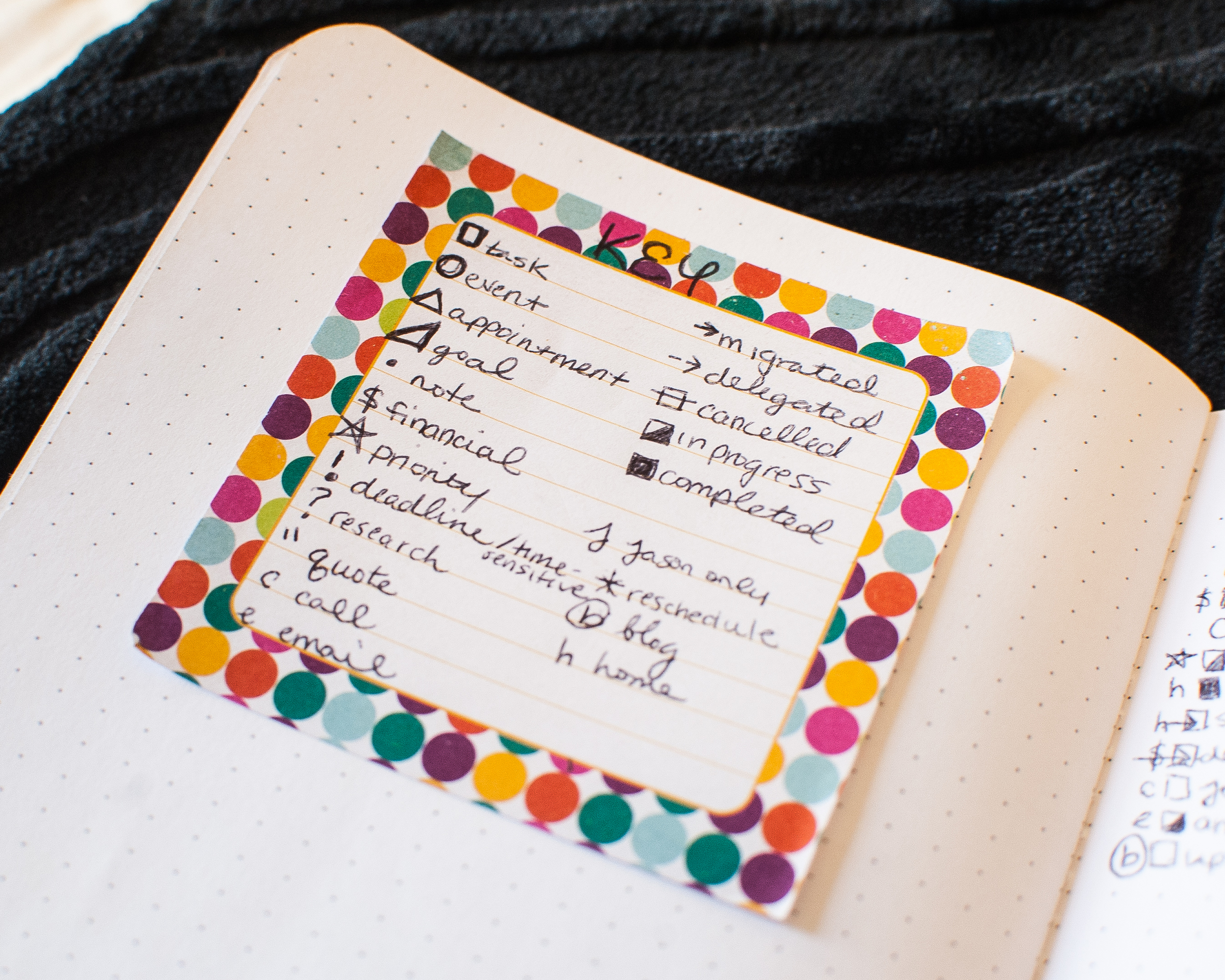
The symbols I use the most frequently are:
- the square for my tasks,
- the circle for events,
- and the bullet point for notes.
The signifiers I use the most are:
- the wide star for priority items,
- the thin star for items to be rescheduled,
- the circled "b" for blog tasks,
- and the "c" and "e" symbols for calls and emails.
The 5 status symbols in the upper right hand corner of my key are as follows:
- an arrow to show that the task was migrated,
- a dashed arrow to show that the task was delegated,
- a line through the symbol to show that the task was cancelled,
- a half filled in symbol to show that the task is in progress,
- and a completely filled in symbol to show that the task was completed.
A Day in the Life of a Bullet Journal
I usually write my daily plan the night before or in the morning over a cup of coffee with my fiancé. Here is an example of what a day might look like in my bullet journal:
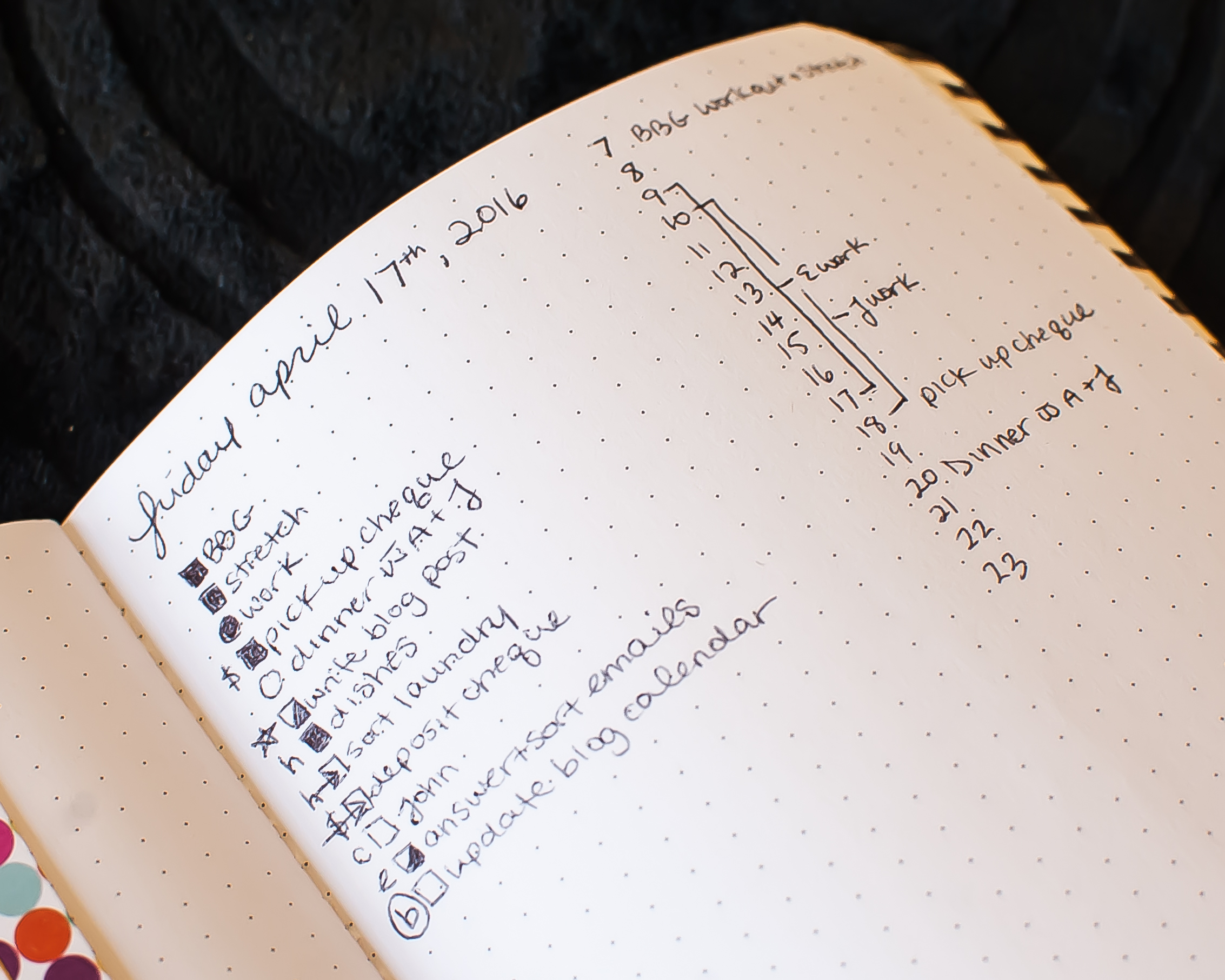
I start by writing the date, and under that start to write in tasks and events I have scheduled for the day. I also like to write an hour by hour planner to the right of my bullet journal points to have a visual cue of tasks or events by time of day (this is not part of the bullet journal system, just something I like to use!). As the day progresses I add items as needed and fill them in as they are completed. When I realize that an item won't be done that day, or decide not to do it until another time, I write in the migrated arrow. If I'm migrating it to the following day I don't bother to add a date, but if it's being moved further into the future I'll write a little date to the left of the signifier. If things come up during the day that I want to remember but aren't specifically a task, I'll add them after a bullet point to represent a note. At the end of the day I'll review the items, filling them in if they were completed and migrating or cancelling them if they weren't, depending on if they are still necessary.
Numbering Pages and Indexing
Another great part of the bullet journal system is numbering pages and creating an index either at the front or the back of your notebook to keep track of important entries you might want to refer to again and again. I haven't found this necessary in my daily planner (as the entries are chronological and easy to find), but have tried it in my general notebook and found it SO helpful!
Now, some people use their bullet journal for everything; daily planning and otherwise. The problem with that method for me is that I like to take my daily planner everywhere in my purse, so I like it to be small and portable. However, when I'm working on planning (my wedding, finances, meals, or blog posts), taking notes, or anything else I may need a paper and pen to do, I like to use a full 8.5x11 page. Since these preferences aren't compatible, I keep my daily planner and general notebook separate.
Monthly Planning
I love using a calendar to see my month at a glance, and this is where I like to play with colour! I find that it's easier to write with one pen day to day, as I can easily bring it with me and add things wherever I am without messing with my colour system. If it made practical sense to carry six coloured pens with me in my purse everywhere I went I would colour-code my daily planning, too, believe me!
Here's the month view in my daily planner:
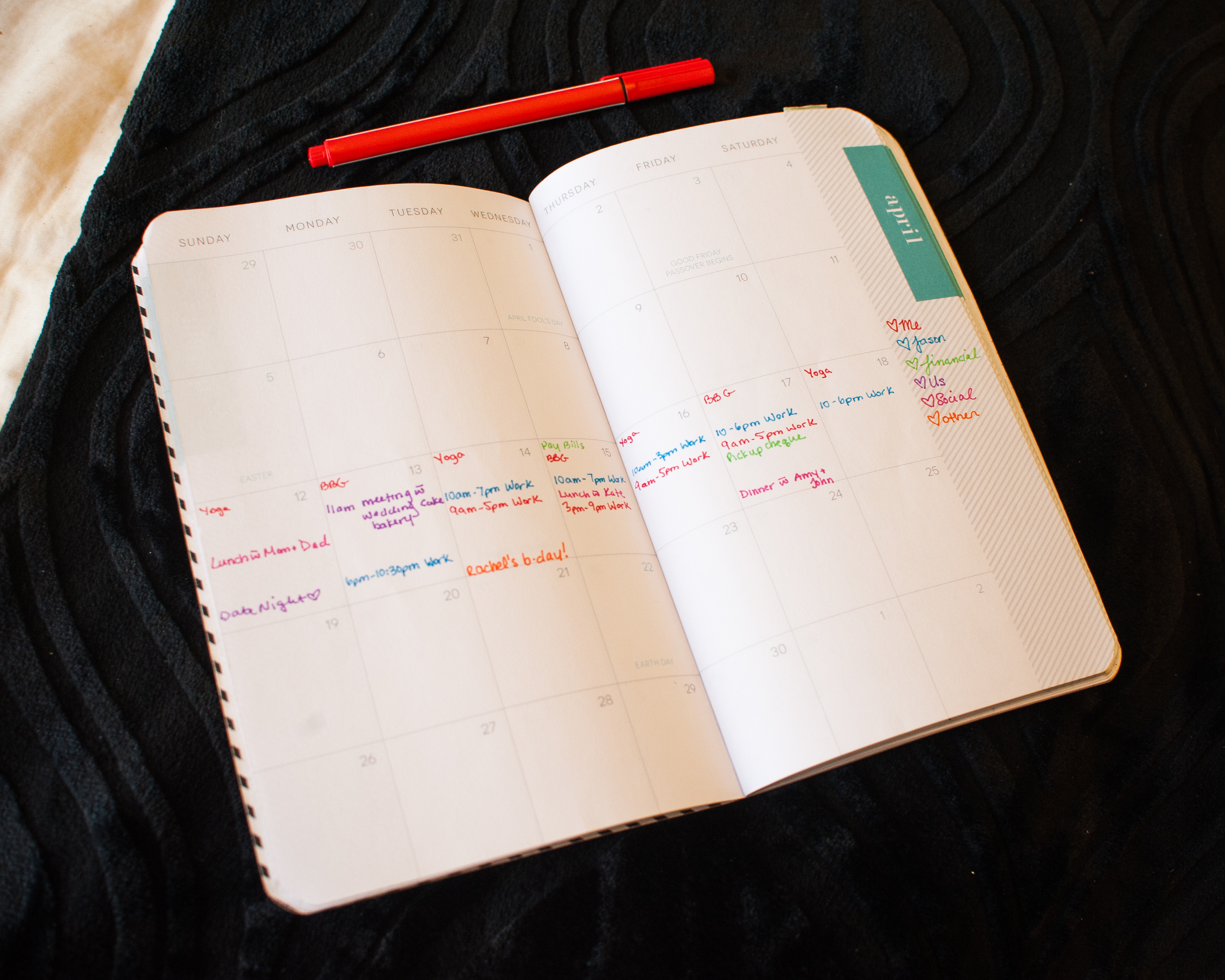
And a close up of an example week:
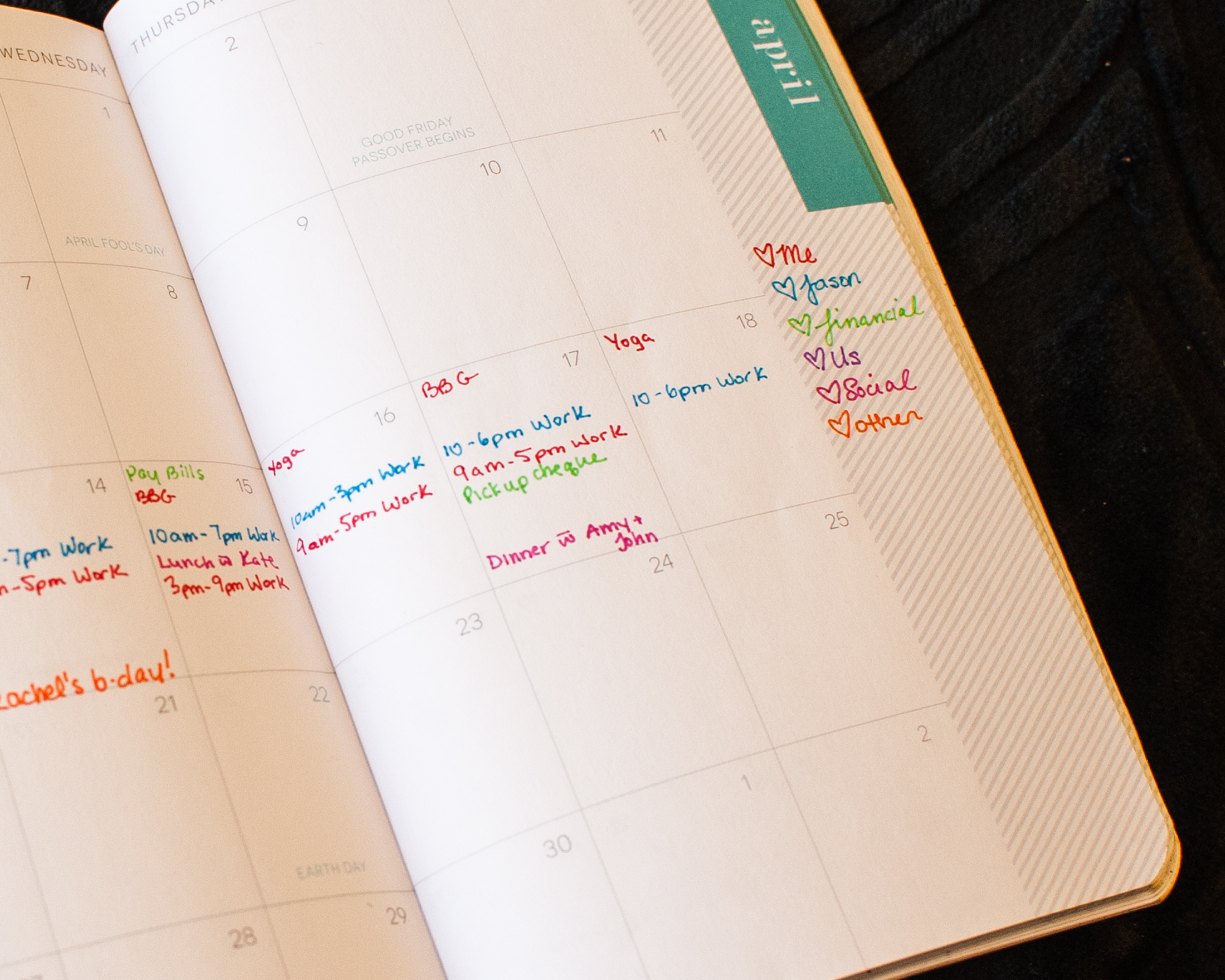
I've found in the past couple months of using this planner that six colours is enough to cover the most frequent events that come up in my life. Red (my favourite colour) is for things that I'm doing alone (going to work, working out), blue is for things my fiancé, Jason, is doing alone, green is for all financial reminders (like paying bills or picking up a cheque), purple is for activities that Jason and I do together (date nights, grocery shopping, weekend trips), pink is for social events with friends, and orange is for everything else (general reminders, important dates, medical appointments, and the like). I love this method as it keeps me organized AND looks pretty! What could be better than that? I write events into my calendar as soon as I hear about them so that I won't forget anything, adding them to my daily tasks once I'm planning that particular day.
You Might Also Like: 5 Steps For Setting Great Goals
So you want to start a bullet journal...
My advice for anyone thinking of implementing the bullet journal system into their life (and I recommend it whole-heartedly!) is to first take a look at the original creator's website. Once you have a feel for the original system I suggest you check out what different people are doing to get inspired and then throw away anything you don't need and make your own version! You can add or delete things as you go to find what works best for you, and sooner than you'd think you'll find you have an awesome, tailor-made system that keeps you organized and on track all day long!
For a starting place to check out other examples of bullet journals, take a look at my organization board on Pinterest, where I have tons of organizational tips and tricks:
I'd also suggest using a journal with dots or a grids over lines, as I feel they lend themselves better to this system. I really love my May Designs notebook with two-page calendars for every month of the year followed by dotted pages. They have all kinds of different formats for the interior of your notebook, as well as fun personalized exteriors, so you should really check them out! (I am not being paid to rave about May Designs, I'm only middle obsessed with them. Just ask my fiancé!) With all of that said, I hope you give bullet journalling a try and that you get as much out of it as I have so far!
Until next time,

Are you going to start a bullet journal? Let me know in the comments below! Alternatively, do you already use this method? I'd love to hear what you think about it and what you do differently!
Also, be sure to use the sign up form at the bottom of the page to get updates from me and new blog posts right to your inbox!



Are Vegans Chronically Iron Deficient?
The omnivorous lay person's biggest worry for my health as a vegan, after my protein intake (and if you're worried, don't be. Check out my article Vegans vs Protein!), is where I get my iron. My response is usually simply: "From plants." (Because, well, duh. I only eat plants.) But what is the scientific reality of reaching my Daily Recommended Intake of iron on a plant-based diet? Get ready for some science, dear readers. Once I finish singing the Bill Nye the Science Guy theme song, of course.
The omnivorous lay person's biggest worry for my health as a vegan, after my protein intake (and if you're worried, don't be. Check out my article Vegans vs Protein!), is where I get my iron. My response is usually simply: "From plants." (Because, well, duh. I only eat plants.) But what is the scientific reality of reaching my Daily Recommended Intake of iron on a plant-based diet? Get ready for some science, dear readers. Once I finish singing the Bill Nye the Science Guy theme song, of course.

First things first...
What is iron anyway?
Iron is a mineral found in nature which is essential to the normal functioning of the human body. Iron is a major component of hemoglobin, the oxygen binding protein of red blood cells which transfers oxygen from the lungs to all of the tissues of the body. Iron is also a component of the oxygen storage unit of muscle cells, myoglobin, which provides working muscles with oxygen.
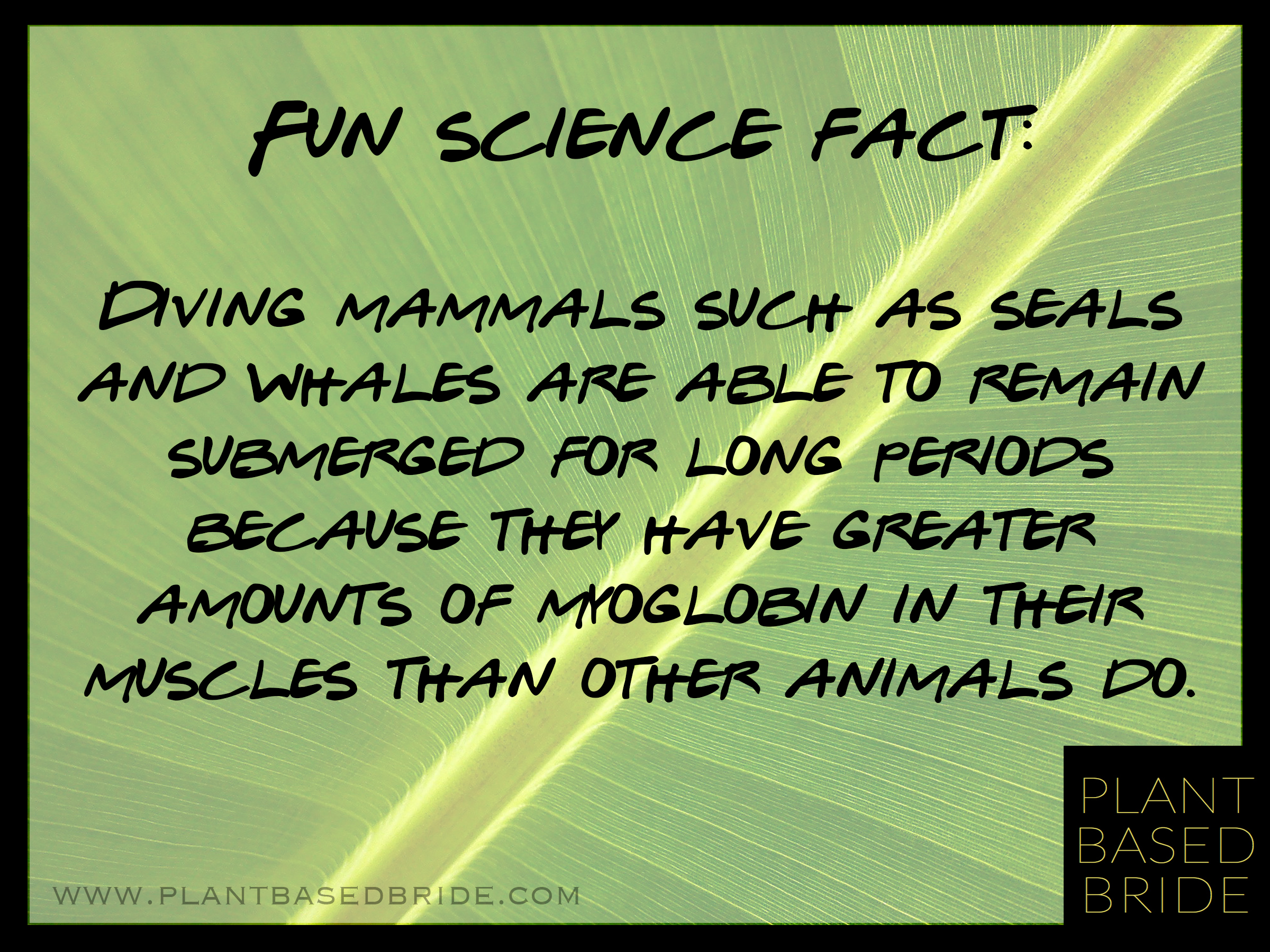
My fiancé thinks I should write a post about training your muscles to be like seal and whale muscles. It's not completely out of the running...
Iron is necessary for proper human growth and development as well as normal cellular functioning and synthesis of some hormones and connective tissues. Both myoglobin and hemoglobin have a molecular constituent called heme which allows them to combine reversibly with oxygen. Iron can be found in the foods we eat as either heme or non-heme iron.
What's the difference between heme and non-heme iron?
Dietary iron has two main forms: heme and non-heme. Heme iron is formed when non-heme iron combines with protoporphyrin IX (a naturally occurring molecule in the body). This combination can happen before the iron is absorbed or within the body after it is ingested Plants, fortified foods, and supplements contain only non-heme iron while meat (including seafood and poultry) contains both non-heme (~55-60%) and heme (~40-45%) iron. Meat, especially red meat, is the best known source of heme iron. This is because when humans eat meat they consume the blood proteins (hemoglobin) and muscle proteins (myoglobin) contained in the flesh of the animal. The animal in question created heme iron in its body while it was still alive by combining the non-heme iron it ingested in its food with the essential molecules generated in its body. Those who eat meat are taking advantage of this pre-completed process.
The good news for vegans and vegetarians out there is that humans can survive on a diet that provides solely non-heme iron. Once the non-heme iron is absorbed in our bodies it is combined with protoporphyrin IX and is put to work storing and transporting oxygen in our cells. But if non-heme iron is a perfectly acceptable sole source of iron in a human's diet, why does everyone claim that eating heme iron is better? Bioavailability is the answer.
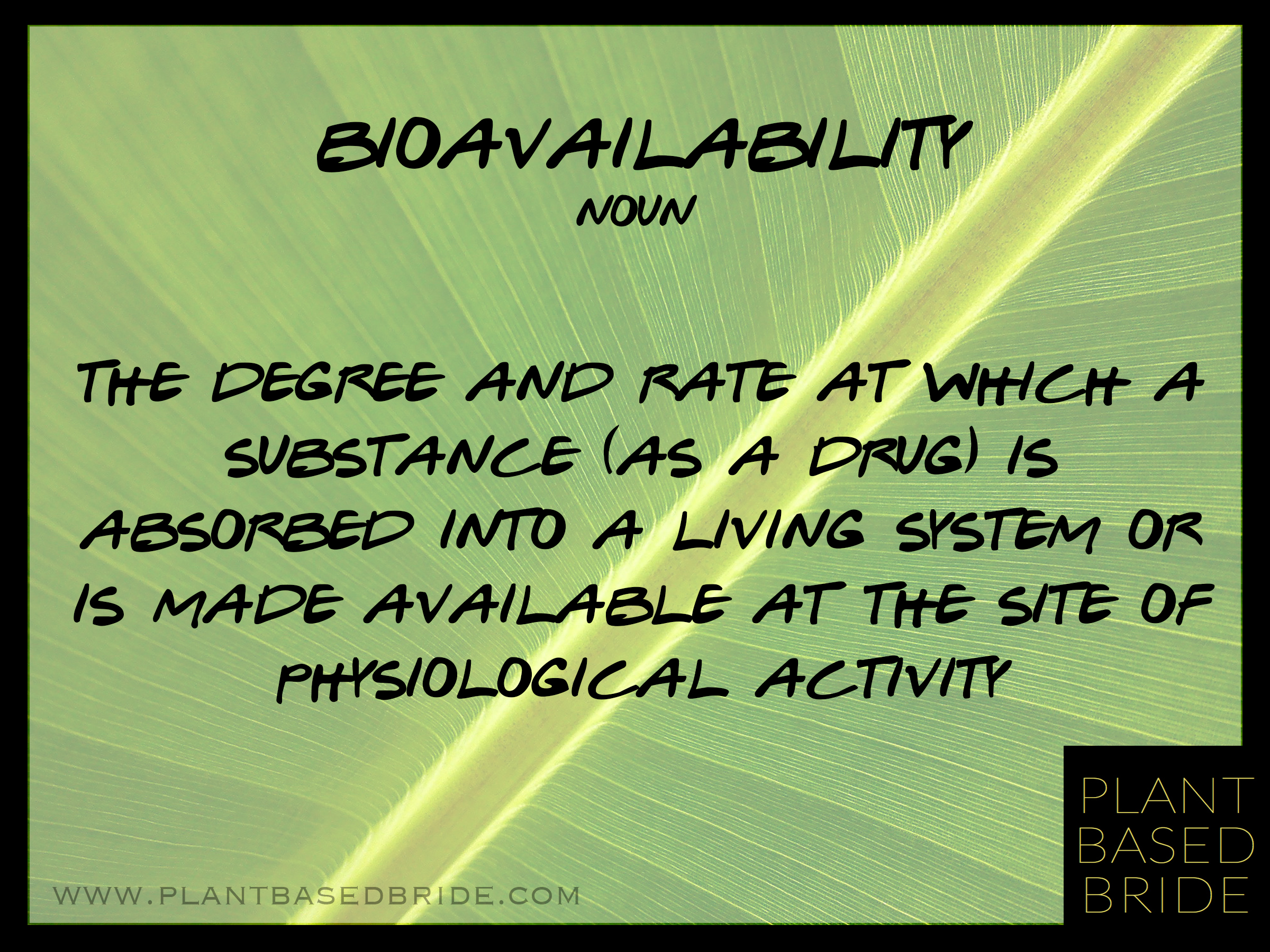
Bioavailability is a complicated thing. Researchers don't agree on the exact percentages of each type of iron that we can absorb, and the exact absorption rate is influenced by a whole host of factors. We know that iron differs from other minerals because its balance in the body is regulated entirely by absorption; as there is no physiologic mechanism for the excretion of iron. Algorithms have been developed to estimate bioavailability in single meal studies, however, these algorithms tend to underestimate bioavailability and data from single meal studies exaggerates the effects of individual dietary factors on iron absorption. The only thing researchers DO agree on is that the human body is able to absorb a higher percentage of heme iron than it can non-heme iron that it ingests, in general. The percentages vary from study to study but an example of estimated absorption rates is as follows: non-heme iron 7-11% and heme iron 15%.
So if we don't know the exact bioavailability of each type of iron, what do we know? Much research has been done on the topic of inhibitors and enhancers of iron absorption. Here is a quick list of some of the known factors that can have an effect.
Iron Absorption Inhibitors:
- Phytates are found in whole grains, legumes, nuts, and seeds. They are able to bind to certain dietary minerals including iron, zinc, manganese, and calcium, and can slow their absorption into the body. However, those eating a balanced diet needn't worry about phytates. As a vegetarian or vegan, reducing your intake of wheat bran, as well as cooking and soaking grains before eating them can help diminish the effect of phytates. It's also good to remember that phytates also have positive health benefits including reducing inflammation, lowering food's glycemic load, reducing cardiovascular disease, and stopping the proliferation of cancer cells in laboratory research.
- Polyphenols in black tea, herb tea, wine, and spices can have an effect on non-heme iron absorption depending on their quantity and type. It was shown on a study of Thai women that while turmeric contains more polyphenols than chili, chill had a greater inhibiting effect on iron absorption.
- Calcium was shown to inhibit both heme and non-heme iron absorption in single meal studies, whether it was derived from diet or from supplements.
- Dairy & Eggs. The 2 main types of milk protein, casein and whey, have been shown to inhibit non-heme iron absorption in humans while egg whites added to a meatless meal reduced iron absorption by a whopping 72% in this study.
Iron Absorption Enhancers:
- Ascorbic Acid is a form of vitamin C found in citrus fruits, peppers, cruciferous and leafy vegetables, and more. Many studies have demonstrated its ability to enhance iron absorption and its ability to negate the inhibiting effects of the compounds listed above. Some studies indicate that including ascorbic acid in a meal can increase iron absorption by as much as triple! Cooking and other processing can damage ascorbic acid, removing its enhancing effect.
- Depleted Iron Stores. Iron absorption rates vary wildly between those individuals with sufficient iron and those who are iron depleted. One study found that the estimated absorption of iron in premenopausal women ranged from 13% in women with sufficient iron to 31% in women with depleted iron levels.
Dietary inhibitors and enhancers only affect the absorption of the iron being consumed around the same time, while other factors such as depleted iron stores, genetic disorders, inflammation, obesity, and deficiency in other nutrients in the body affect total iron absorption.
How Much Iron Should You Be Getting Daily?
The table below shows recommended intakes in mg/day.
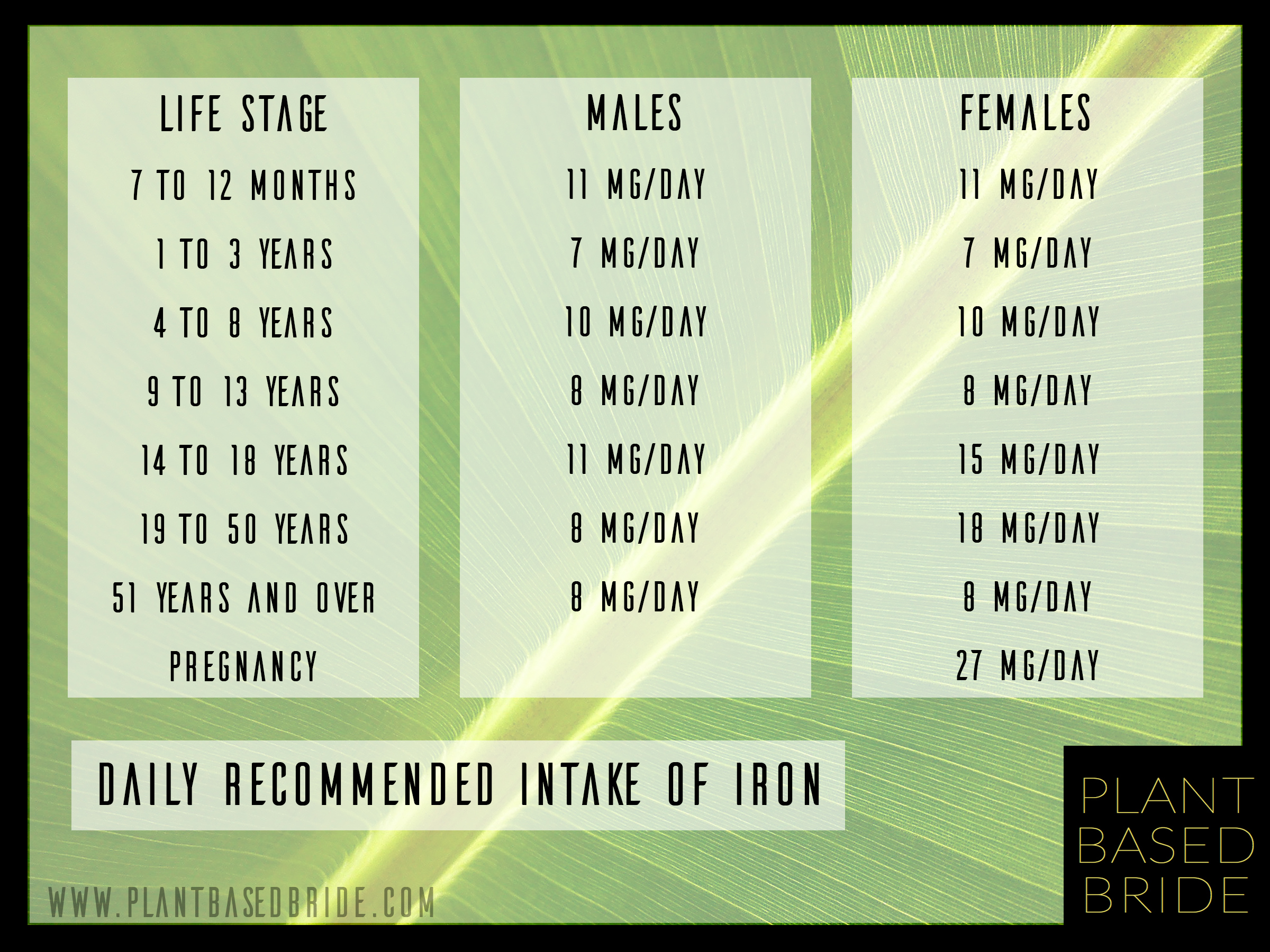
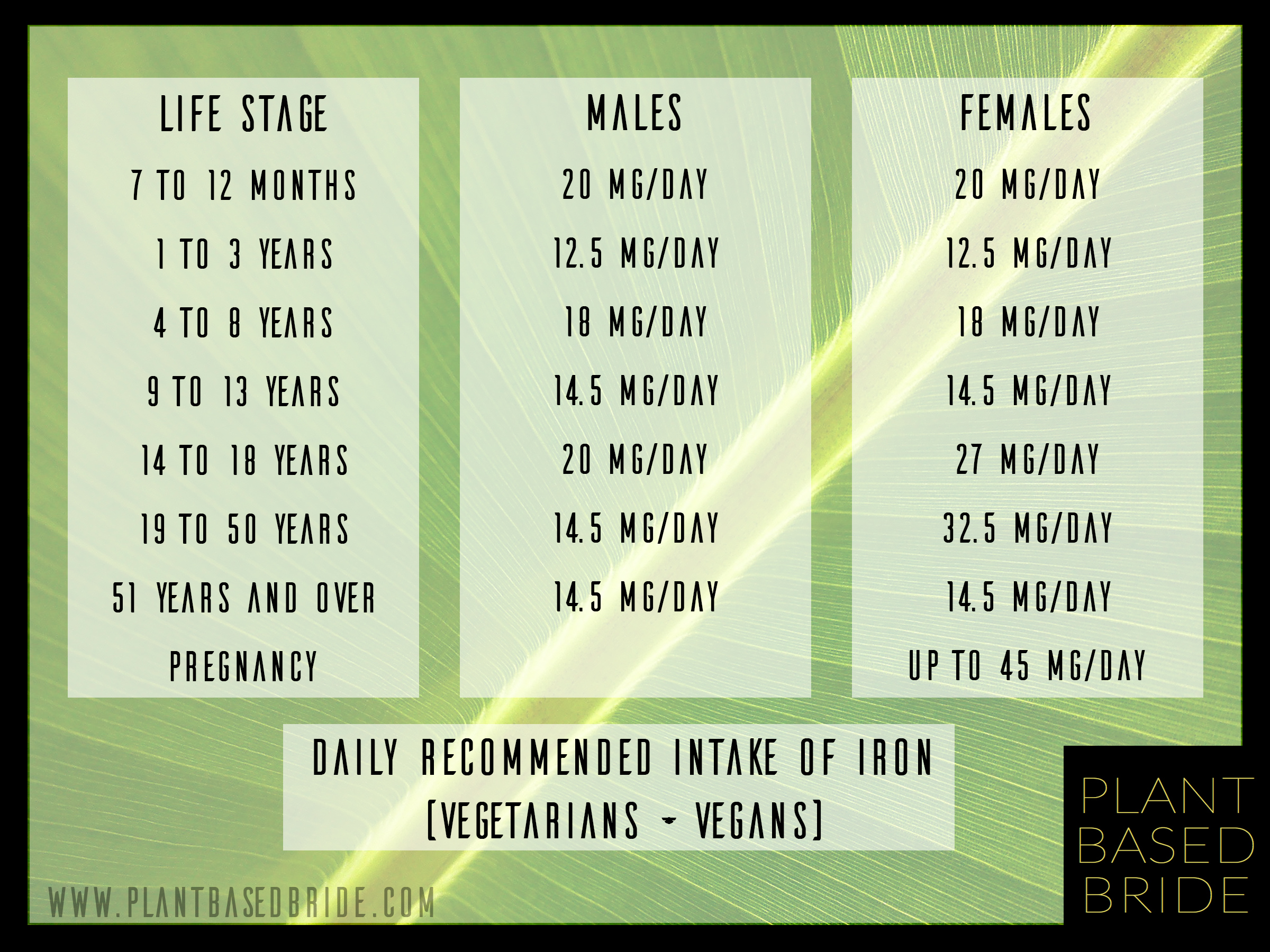
It is generally recommended that vegetarians and vegans get 1.8 times the normal recommended amount of iron daily to compensate for lower absorption rates of non-heme iron. Vegan and vegetarian numbers (those above multiplied by 1.8) are in the table below.
What vegan foods contain iron?
Legumes: soybeans (9mg/cup), lentils (6.5mg/cup), white beans and chickpeas (5mg/cup), tofu and kidney beans (4mg/cup - as much as 5 ounces of sardines)
Grains: quinoa (3mg/cup), brown rice (1mg/cup - equivalent to 3oz of tuna)
Nuts & Seeds: pine nuts (7.5mg/cup - 3 times as much iron as in a cup of turkey), sunflower seeds (5mg/cup), pumpkin seeds (2mg/cup),
Vegetables: tomato paste (8mg/cup - equal amount of iron as in 12oz of ground beef), cooked spinach (6.5mg/cup)
Other: spirulina (32mg/cup - as much iron as is in 53 large hard-boiled eggs), blackstrap molasses (16mg/cup), prune juice (3mg/cup), dried apricots (3.5mg/cup)
So, is it possible to get enough iron on a vegan diet?
Lets say you're the same 25 year old woman we mentioned earlier. Your meat-eating contemporaries are recommended 18mg/day, but you (as a vegan) are told you need 1.8 times that amount daily, or 32.4mg/day. Is it possible?
A meal with 1.5 cups of lentils (9.75mg), 1 cup of tofu (4mg), and 3 cups of cooked spinach (19.5mg) has already surpassed your daily iron needs coming in at over 33mg. And what if you added half a cup of tomato paste (4mg) blended with a tbsp of spirulina (2mg) as a sauce? You'd be approaching the upper levels of what is considered safe iron intake for a day, in one meal. As you can see, a well-planned, balanced diet of whole, nutrient rich foods can easily reach the required iron needs, even taking into account poor absorption rates.
How high is too high: Iron Overdose
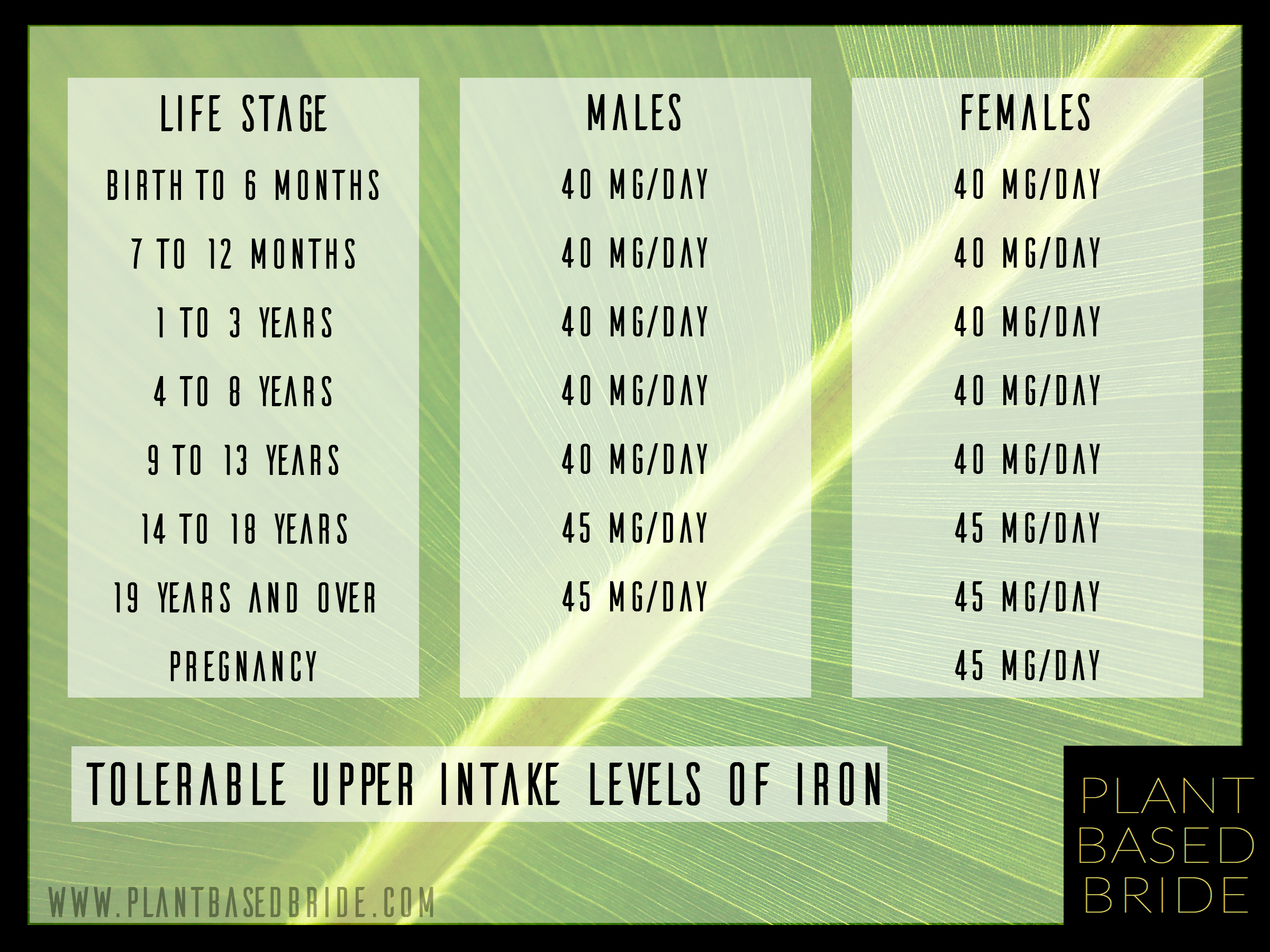
There is little risk of iron overload from diet in adults with normal intestinal function, however, acute intake of more than 20mg of iron per kg of bodyweight from supplements or medication can lead to many unpleasant side effects including constipation, nausea, abdominal pain, vomiting, gastric upset, and faintness. A true overdose of iron (around 60mg in one dose) can lead to multisystem organ failure, coma, convulsions, and even death.
How low is too low: Iron Depletion & Iron Deficiency Anemia
But what if you get enough iron through your food and then lose it? Iron loss through urine, feces, the gastrointestinal tract, and the skin is minimal, however, the major concern is iron loss during menstruation in women, due to the loss of blood. There have been various reliable tests developed over the years to detect early iron store depletion (measuring serum ferritin, a protein found within the cells that store iron in the body), advanced iron depletion (determined by reduced serum iron, amongst other indicators), and iron deficiency anemia (when hemoglobin concentrations in the blood drop below 13g/dL in men and 12g/dL in women). Women should remain aware of their iron intake, especially during their menstruation period, to maintain adequate iron stores in the body.
Iron deficiency is one of the most common nutritional deficiencies, affecting mostly children and women of childbearing age. Anemia symptoms include gastrointestinal disturbances, extreme fatigue, impaired cognitive and immune function, pale skin, impaired temperature regulation, dizziness and headaches. If you recognize these symptoms in yourself please go see a doctor and get tested.
So, are vegans chronically iron deficient?
No. A vegan diet, without supplementation, is completely satisfactory for maintaining healthy iron levels in the body. If you are concerned about absorbing enough of the iron you eat, try combining foods high in ascorbic acid with your meals, soaking your grains, and avoiding tea and wine close to meal time. If you're the type who likes to take extra precautions you can take daily iron supplements to ensure full stores. Just make sure you aren't taking to much! If you keep these things in mind you should have no problem maintaining sufficient iron levels for all of your oxygen storing and transporting needs. Happy blood, happy body. Happy body, happy you!
Until next time...

Do you track your iron intake? What are your thoughts on iron supplementation? Let me know in the comments below!
Also, be sure to use the sign up form at the bottom of the page to get updates from me and new blog posts right to your inbox!
Sources
- https://ods.od.nih.gov/factsheets/Iron-HealthProfessional/
- http://www.britannica.com/science/myoglobin
- http://www.ncbi.nlm.nih.gov/pubmed/23139325?dopt=Abstract
- http://www.nlm.nih.gov/medlineplus/ency/article/003490.htm
- http://www.ncbi.nlm.nih.gov/pubmed/9563847?dopt=Abstract
- http://journals.plos.org/plosone/article?id=10.1371/journal.pone.0111824
- http://ajcn.nutrition.org/content/91/5/1461S.full
- http://ajcn.nutrition.org/content/76/2/419.full
- http://www.irondisorders.org/iron-we-consume/
- http://www.drweil.com/drw/u/QAA400758/Are-Phytates-Bad-or-Good.html
- http://journals.cambridge.org/action/displayAbstract?fromPage=online&aid=606480&fileId=S0954422400000706
- http://jn.nutrition.org/content/136/12/2970.abstract?ijkey=f070f52967954ed45ec2dda737a97385312e1bb2&keytype2=tf_ipsecsha
- http://ajcn.nutrition.org/content/47/1/102.abstract?ijkey=687bd4333f9f4042220c358f35db5139d6bbf776&keytype2=tf_ipsecsha
- http://ajcn.nutrition.org/content/49/3/546.abstract?ijkey=966501a9ffaf4120b1549d10ca4398855e263b5f&keytype2=tf_ipsecsha
- https://www.eatrightontario.ca/en/Articles/Nutrients-(vitamins-and-minerals)/Iron-Matters.aspx#.VbkR7c7BFFJ




25 Surprising Non-Vegan Foods
It can be intimidating to go vegan. Believe me, I know! After 8 months as a vegetarian and researching veganism almost daily I thought I knew without a doubt what foods were and were not vegan. Unfortunately, I was wrong. Over the past 2 and a half years eating a plant based diet I have come across many non-vegan foods that shocked me. And while I was lucky enough to discover the majority of these foods before eating them, not everyone does. Food companies love to include animal products in everything, and I mean EVERYTHING. They even sneak them into "vegan" products! Here is a list of 25 surprising non-vegan foods to avoid.
It can be intimidating to go vegan. Believe me, I know! After 8 months as a vegetarian and researching veganism almost daily I thought I knew without a doubt what foods were and were not vegan. Unfortunately, I was wrong. Over the past 2 and a half years eating a plant based diet I have come across many non-vegan foods that shocked me. And while I was lucky enough to discover the majority of these foods before eating them, not everyone does. Food companies love to include animal products in everything, and I mean EVERYTHING. They even sneak them into "vegan" products! Here is a list of 25 surprising non-vegan foods to avoid.
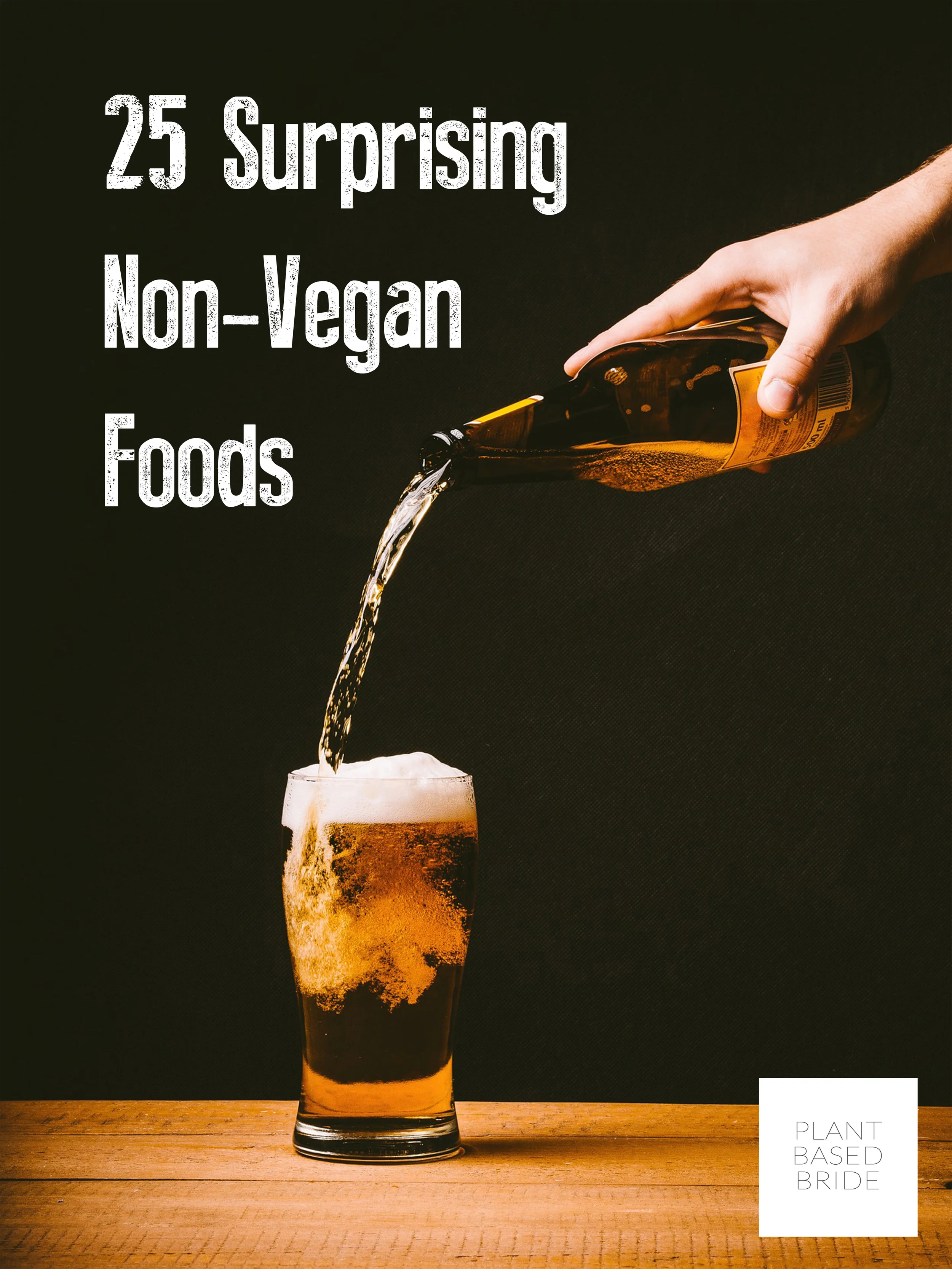
- Beer... many brands use a membrane derived from the bladders of fish to filter their brews. Check out Barnivore to find out if your favourite beer (or wine, or liquor) is cruelty-free!
- White Sugar... some brands process their sugar using bone char to give it its bright white colour (watch out for brown sugar too; it may be processed as white sugar and then have molasses added to make it brown). Always buy beet sugar (not refined using bone char) or organic cane sugar (bone char is not considered organic).
- Non-Dairy Creamer... can contain milk-derived ingredients such as caseinate.
- Red Dye... a popular brand of red dye called Carmine (often listed as Natural Red #4 in ingredient lists) is coloured using the scales of tiny insects.
- Jello... contains gelatin which is derived from animal bones, connective tissues, and organs.
- Vitamin D Fortified Foods... the source of vitamin D may be lanolin, derived from sheep's wool.
- Chewing Gum... often contains animal-derived glycerin.
- Cake Mix... may contain beef fat (often listed as lard in the ingredients).
- Worcestershire Sauce... traditionally contains anchovies.
- Apple Juice... may be clarified with isinglass (obtained from the dried swim bladders of fish). This one I find especially disturbing, having been a HUGE apple juice fan as a child.
- Jam... may contain gelatin.
- Tortillas... traditionally made with lard.
- Marshmallows... often contain gelatin.
- Margarine... may contain gelatin, casein (milk protein), or whey.
- Frosted Mini Wheats... contains gelatin.
- BBQ Chips... may contain traces of milk or animal fat.
- Vitamins and Supplements... often contain animal products. Read the ingredients carefully!
- Orange Juice... can be fortified with omega 3s derived from fish.
- Refried Beans... traditionally made with lard.
- Bagels... the enzyme L. Cysteine is used as a dough conditioner and is derived from poultry feathers.
- Packaged Peanuts... may contain gelatin.
- Soy Cheese... may contain casein. Just because a product's only purpose would seem to require its veganism does not mean it's animal product free! Make sure to read the ingredients carefully, even on "vegetarian" and "vegan" products.
- Altoids... contain gelatin.
- Pad Thai... often contains fish sauce. Be sure to ask!
- French Fries... may be fried in animal fat.
You Might Also Like: 10 Reasons To Go Vegan!
Lucky for us many brands provide vegan options of these foods. Make use of google and sites like Vegetarians in Paradise to investigate brands or products, and always read the ingredients!
Until next time,

Which food surprised you most? Is there a surprisingly non-vegan food I missed? Let me know in the comments below!
Also, be sure to use the sign up form at the bottom of the page to get updates from me and new blog posts right to your inbox!
Coined by Elizabeth Jean @xparmesanprincessx, the personal curriculum trend is about creating a self-directed learning plan focused on areas of personal interest, loosely based on a school curriculum structure, including things like assigned reading, goals, assignments, and final projects.
At its core, the personal curriculum movement is about celebrating lifelong learning and intellectual curiosity. It's about being more intentional about how we spend our time when we're not sleeping, or at work, or doing the basic maintenance or admin or chores to keep our lives going. It's about using our free time to enrich our lives in a way that is purposeful and intentional and joyful, indulging our curiosity as adults, even once we're outside of structured school environments, getting excited about learning and allowing ourselves the freedom to go down those rabbit holes in our special interests, to challenge our brains in ways that we maybe don't get the chance to in our day-to-day lives.