

the blog.

Cruise Capsule Look Book
Hello from Miami!
This week I'm sharing a quick video showing my packing process as well as some outfit ideas from my cruise capsule wardrobe. There also may or may not be kittens being adorable. You'll have to watch to know for sure!
Hello from Miami!
This week I'm sharing a quick video showing my packing process as well as some outfit ideas from my cruise capsule wardrobe. There also may or may not be kittens being adorable. You'll have to watch to know for sure!

Watch the video on YouTube HERE!
LINKS TO THINGS I TALKED ABOUT...
Cruise Capsule Wardrobe: http://plantbasedbride.com/blog/cruise-capsule-wardrobe
How To Build a Capsule Wardrobe: http://plantbasedbride.com/blog/how-to-build-a-capsule-wardrobe
Fall Capsule Wardrobe: http://plantbasedbride.com/blog/fallcapsule2015
Winter Capsule Wardrobe: http://plantbasedbride.com/blog/winter-capsule-wardrobe
Earth Science Mint Rosemary Deodorant: http://www.amazon.com/Earth-Science-Natural-Deodorant-Rosemary/dp/B000Q3Y9X0
Vegetology Omega 3: https://www.vegetology.com/collections/vegans/products/opti3
Vegetology Vitamin D3: https://www.vegetology.com/collections/vegans/products/vitashine-2500iu-tablets
Why I add a B12 Supplement to my Vegan Diet: http://plantbasedbride.com/blog/b12
I hope you enjoyed it!
Until next time,

Have you ever travelled for work? How was it for you?








Cruise Capsule Wardrobe
Last year I spent 8 months working for the mouse. Mickey Mouse, that is! I completed a contract as a performer on the Disney Wonder and had a ball of a time.
The only problem? I packed WAY too much. To my credit, I had no idea what one should pack for 6 months at sea… but a guitar, a backpack, and two huge suitcases weighing in at over 70 lbs each? Just a little bit of overkill. (I did eventually get the suitcases down to under 60 lbs each, but it was painful. And believe me, lugging those babies around in the bowels of a ship was NOT a cake-walk).
So as I prepare for my second contract, a quick month, I know I can do better. I am a minimalist now, after all. I have Marie Kondo on my side. I have KonMari in my blood. Ok, maybe I’ve taken this a bit too far… Anyway, I am definitely better equipped this time around to pack minimally for maximal impact.
As I still vividly remember how painful it was trying to decide what to bring and what to leave behind last fall, I thought I would take you along for the ride in the hopes that you can learn from my mistakes and be ready for any opportunity that comes your way!
Last year I spent 8 months working for the mouse. Mickey Mouse, that is! I completed a contract as a performer on the Disney Wonder and had a ball of a time.
The only problem? I packed WAY too much. To my credit, I had no idea what one should pack for 6 months at sea… but a guitar, a backpack, and two huge suitcases weighing in at over 70 lbs each? Just a little bit of overkill. (I did eventually get the suitcases down to under 60 lbs each, but it was painful. And believe me, lugging those babies around in the bowels of a ship was NOT a cake-walk).
So as I prepare for my second contract, a quick month, I know I can do better. I am a minimalist now, after all. I have Marie Kondo on my side. I have KonMari in my blood. Ok, maybe I’ve taken this a bit too far… Anyway, I am definitely better equipped this time around to pack minimally for maximal impact.
As I still vividly remember how painful it was trying to decide what to bring and what to leave behind last fall, I thought I would take you along for the ride in the hopes that you can learn from my mistakes and be ready for any opportunity that comes your way!
My Top 3 Tips for Practical Packing
Packing sucks.
The majority of the population (including myself) hates doing it. I know quite a few people who would rather trash all of their worldly belongings and start again rather than pack for a move. But what about when your packing for a trip? You’re going somewhere potentially unfamiliar, where you may be unable to purchase necessities (especially if you live an ethical lifestyle). You need to bring the basics with you, at the very least.
So how can we make packing more palatable? With my top 3 tips for practical packing, of course! (Can you tell I love alliteration? I thought so.)

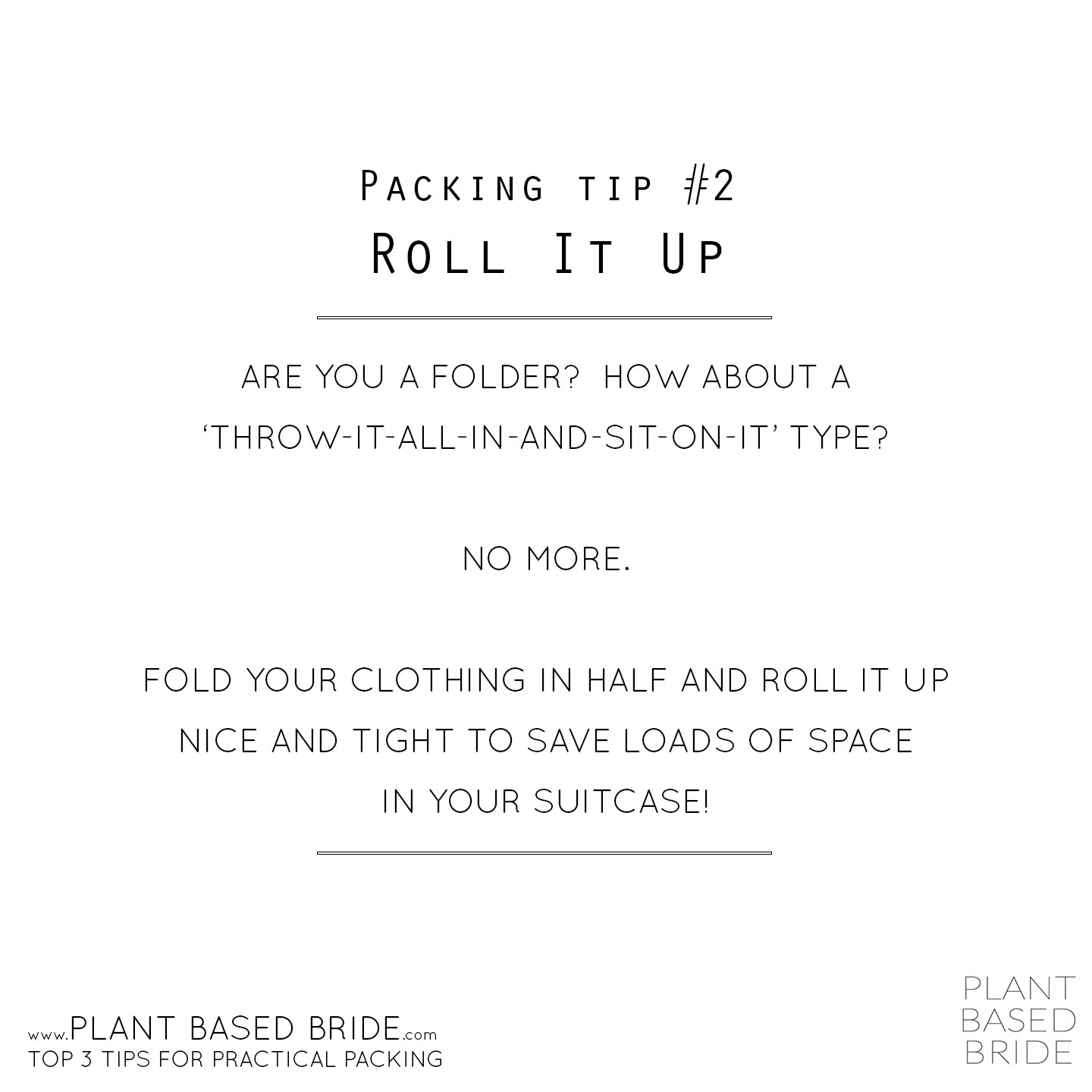
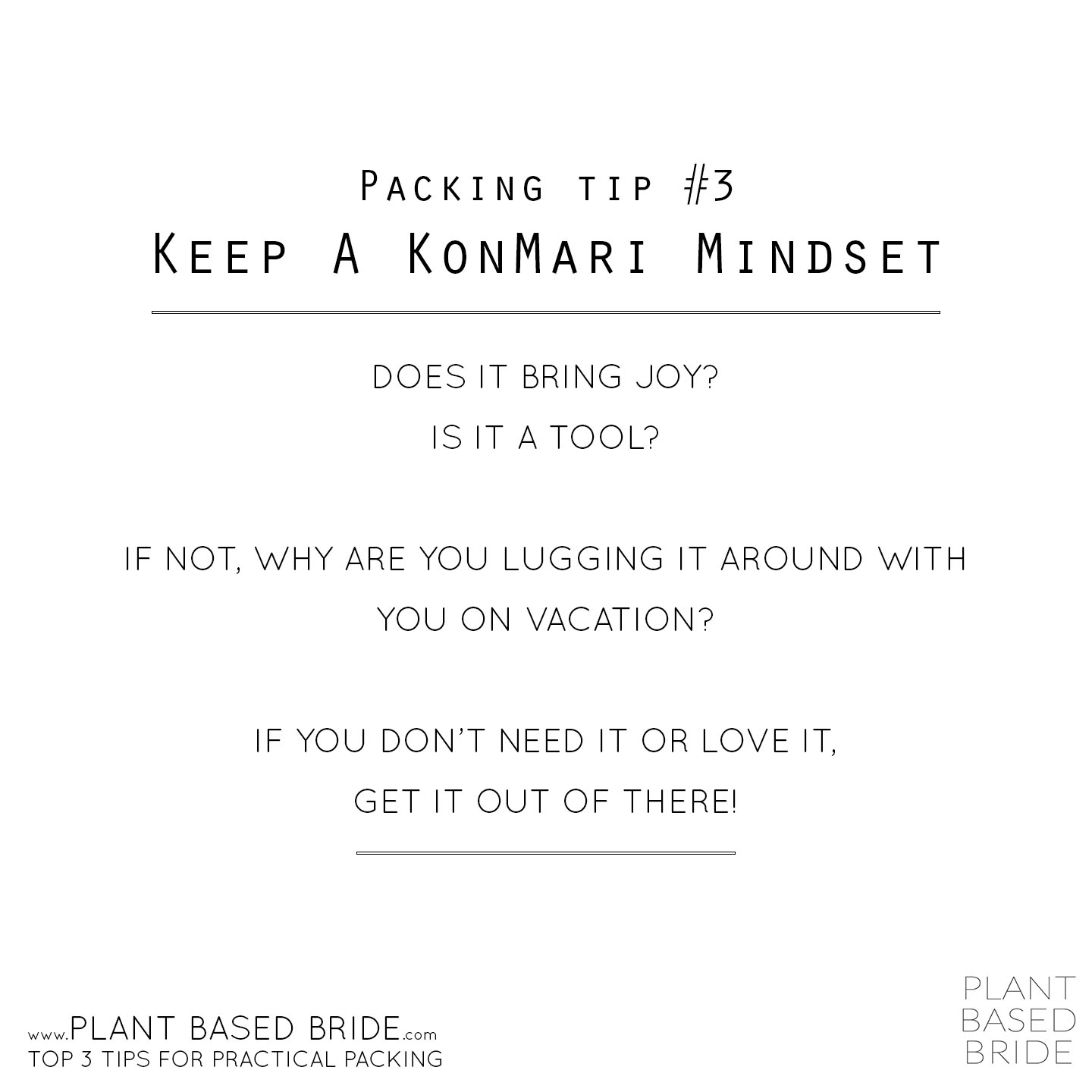
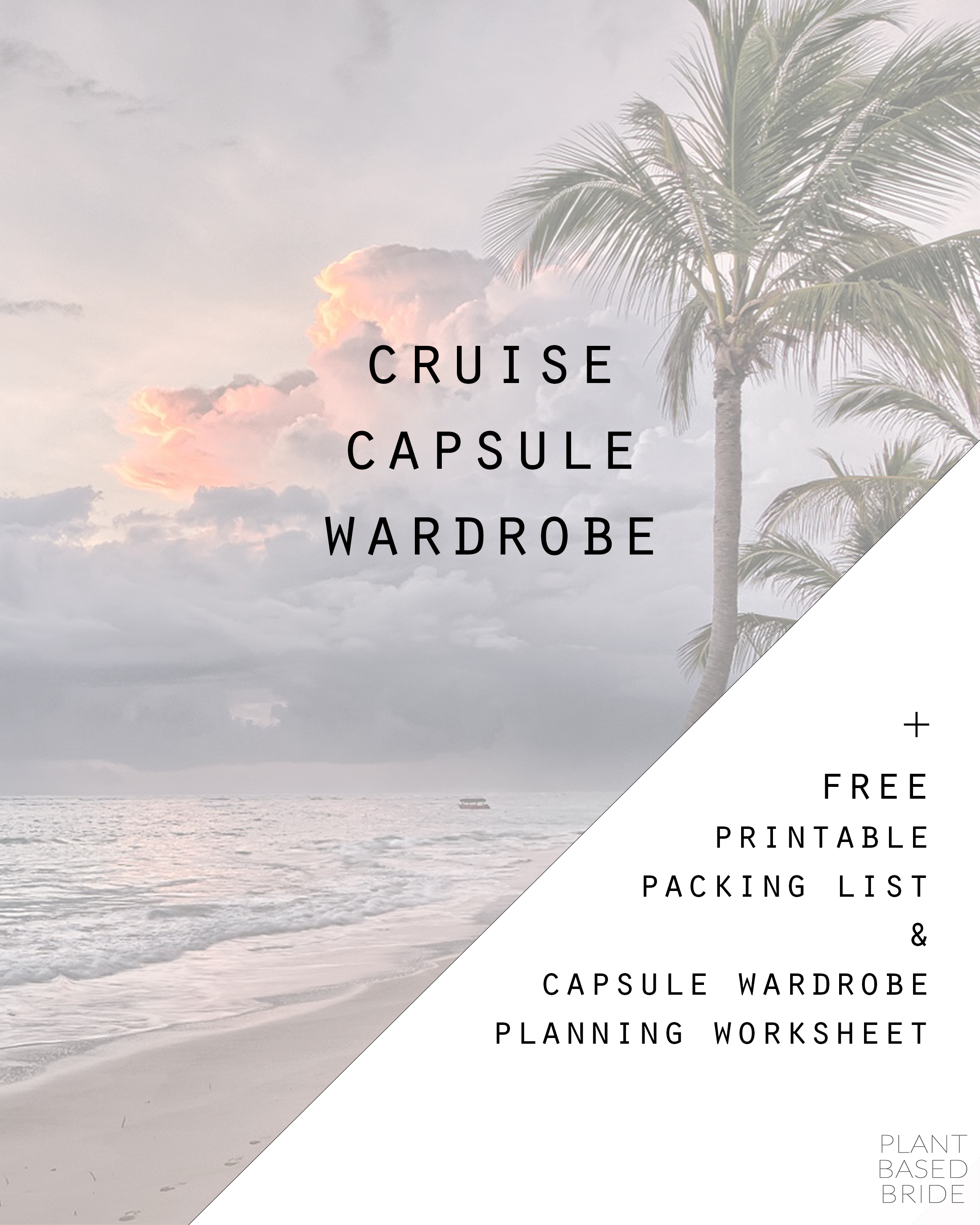
I also created a Packing Checklist to help you remember every important item!
Building a Capsule Wardrobe
A capsule wardrobe is a small, intentional, daily wardrobe made up of pieces you love, fit you and your lifestyle, and all work together.
I wrote a detailed post explaining the capsule concept as well as a thorough how-to for building your own, go read it HERE, get familiar, then come back and read on!
If you’re already on the capsule wardrobe train (Hi, my name’s Elizabeth. Let’s be best friends.) I’ll get right into my streamlined capsule process!
To begin the curation process for my third capsule wardrobe I sat down, asked myself a few simple questions, and put pen to paper. Here are the 7 questions and my responses to help you get a fuller picture of the process:
- How long will I wear this capsule? One month.
- What will the weather be like? Temperatures ranging from 20-30 degrees celsius, mostly sunny, possible rain.
- What will my typical day look like? (Consider formality, dress codes, activity level and type) Exercise and rehearsals (requiring active wear), time spent in crew areas and in my cabin, time spent in guest areas (comply to dress code), time spent at the beach and swimming, time spent in port.
- What types of special events and activities will I be participating in? Crew events, special events in guest areas.
- 3 words that describe my ideal style: Minimal, Neutral, Light
- What kind of outfits do I love/inspire me? Pin em! Capsule and Style Pinterest boards
- What is my colour palette? Black, white, grey, and beige (neutrals) with a few pops of colour and pattern
Want to use these questions to build your next capsule? Use the form below to join the Plant Based Bride community and get your download link for the free printable!
Once I answered these questions, it was time to shop my closet!
The Cruise Capsule
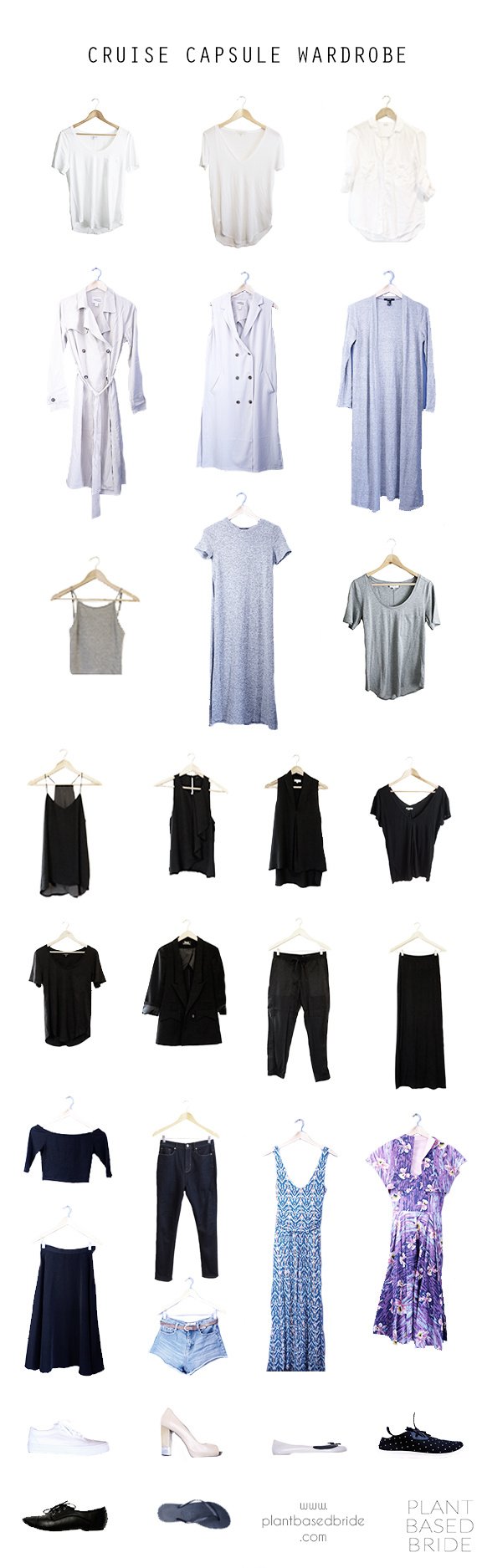
You may recognize some pieces from my fall and winter capsule wardrobes in here, but there are also some exciting new items!
With warm weather on the horizon, I turned my focus to lighter pieces - both in weight and colour. While black is and always will be a staple colour in my wardrobe, white, grey, and shades of beige have made their mark on this capsule. I also brought back a touch of colour and pattern that was completely lacking from my winter collection as statement pieces that stand out on the backdrop of neutrality.
As you saw in my answers to the planning questions, I was hoping for a minimalist, neutral, and light feel in my capsule. Flowy fabrics, long cuts, draping, and soft tailoring pull everything together for me.
For anyone interested in the pieces featured, the following is a list of exact or similar items:
TOPS (16)
- white tee - aritzia
- white v neck tee - urban outfitters
- white button down - anthropologie
- beige trench - similar
- beige vest - similar
- long grey cardigan - similar
- grey cropped tank - brandy melville
- long grey tee with slits - similar
- grey tee - aritzia
- black & grey reversible cami - similar
- black sleeveless swing blouse - zara
- black sleeveless v neck blouse - aritzia
- black deep v neck tee - similar
- black t-shirt - aritzia
- black blazer - similar
- black cropped tee - similar
BOTTOMS (5)
- black track pants - gap
- black maxi skirt - brandy melville
- a-line skirt - american apparel
- high waisted jeans - urban outfitters
- high waisted shorts - similar
DRESSES (2)
SHOES (6)
I have to say that I am absolutely LOVING building and wearing capsule wardrobes. This is becoming a way of life. I’m hoping to progress to the point where I can let go of everything not including in the past 4 capsules (not worn in a year) and reduce my entire wardrobe to under 175 pieces total! (That may sound like a lot to you, but to me that’s TINY! I started out with over 500 EASY before my KonMari purge!)
I am so excited to try out the capsule model while working at sea, it feels like the perfect time to utilize this kind of dressing as you’re already limited by what you can fit in your luggage.
Well, my bags are packed. I have a backpack, my guitar, and one suitcase weighing 57 lbs (darn having to pack enough vegan and cruelty-free skin care, hair care, and body care for a month!) and I have to say I am very pleased. I don't claim to be the perfect minimalist. I definitely don't have it yet. But it feels so good to be on my way!
What would are the three words you would use to describe your ideal wardrobe?
Let me know in the comments below!
Until next time,



Is Honey Vegan?
Is honey vegan? That's a question I hear a lot from the veg-curious. I understand the confusion. Bees aren't animals, right? And they don't get hurt by humans taking their honey, right? I mean, bears do it. Why can't we?
Well, there are quite a few reasons why I (and many) avoid honey. Not the least of which is the 'ick' factor... honey is actually pretty gross when you think about it.
But is it vegan or isn't it?
Is honey vegan? That's a question I hear a lot from the veg-curious. I understand the confusion. Bees aren't animals, right? And they don't get hurt by humans taking their honey, right? I mean, bears do it. Why can't we?
Well, there are quite a few reasons why I (and many) avoid honey. Not the least of which is the 'ick' factor... honey is actually pretty gross when you think about it.
But is it vegan or isn't it?

Let's start out with the definition of veganism.
VEGANISM is a way of living which seeks to exclude, as far as is possible and practicable, all forms of exploitation of, and cruelty to, animals for food, clothing or any other purpose. - The Vegan Society
As you can see, there are two factors which need to be considered when determining if something is vegan or not:
- Does it come from an animal?
- Is the animal exploited or subjected to cruelty to obtain it?
So, are bees animals? The standard definition of an animal is:
ANIMAL, a living organism that feeds on organic matter, typically having specialized sense organs and nervous system and able to respond rapidly to stimuli.
Under this, and many, if not all definitions, bees are very clearly animals. But are they subjected to cruelty or exploited in the process of making and taking their honey? Read on to learn eight reasons why no one should be eating honey, vegan or not:
ONE... Bees don't make honey for you.
Bees don't make honey for you, just like cows don't make milk for you and hens don't lay eggs for you.
You already know this, of course.
'The animals of the world exist for their own reasons. They were not made for humans any more than black people were made for white, or women created for men.' - Alice Walker
So why do we as a species continue to steal the fruits of their labour? Don't you think that perhaps, just perhaps, they make honey for a purpose completely separate from the uses we have made for it?
You might not know that bees work REALLY HARD to make honey.
- Each bee visits between 50 and 100 flowers to fill their crop (second stomach);
- To make 1 lb of honey the bees need to visit around 2 million flowers and fly over 55 thousand miles (that's more than the distance around the world. Times two!);
- Bees spend A LOT of time making honey. In fact, if bees made minimum wage, a jar of honey would cost $182,000.
- If you eat 2 tbsp of honey you are eating the entire life's work of over 36 bees.
Bees don't make honey for our benefit, and we have no right to it whatsoever.

TWO... Stealing is wrong.
No matter how you look at it, we all know that stealing is wrong.
For the religious among you, remember those pesky commandments? What was number 7 (or 8, depending on your religious affiliation) again? Oh yeah...
'Thou shalt not steal.'
Pretty straightforward, if you ask me.
What if you're not religious?
From the criminal code of Canada...
'322. (1) Every one commits theft who fraudulently and without colour of right takes, or fraudulently and without colour of right converts to his use or to the use of another person, anything, whether animate or inanimate, with intent
(a) to deprive, temporarily or absolutely, the owner of it, or a person who has a special property or interest in it, of the thing or of his property or interest in it;
(b) to pledge it or deposit it as security;
(c) to part with it under a condition with respect to its return that the person who parts with it may be unable to perform; or
(d) to deal with it in such a manner that it cannot be restored in the condition in which it was at the time it was taken or converted.'
Again, pretty straightforward (although slightly wordier).
Oh, and there's also just the whole common knowledge part of the equation, best said as a child would put it...
'Don't steal. It isn't nice.'
Seriously. It isn't nice. Stop doing it.
I can just hear you now... but they're just bees... why should we care?
Because bees are REALLY SMART.
How smart?
Bees' brains are only the size of a sesame seed, yet they have a remarkable ability to learn and remember information as well as make complex calculations.
They use 'swarm intelligence' to work together to make decisions based on a multitude of factors and are also able to communicate with each other by way of clear body language.
How? They do a 'waggle dance' in which they indicate the direction of a field of flowers, for example, to which they are hoping to encourage their bee counterparts to travel, and are able to communicate very accurate directions using vector calculus! See the video below for a more in depth explanation:
Pretty cool, huh?
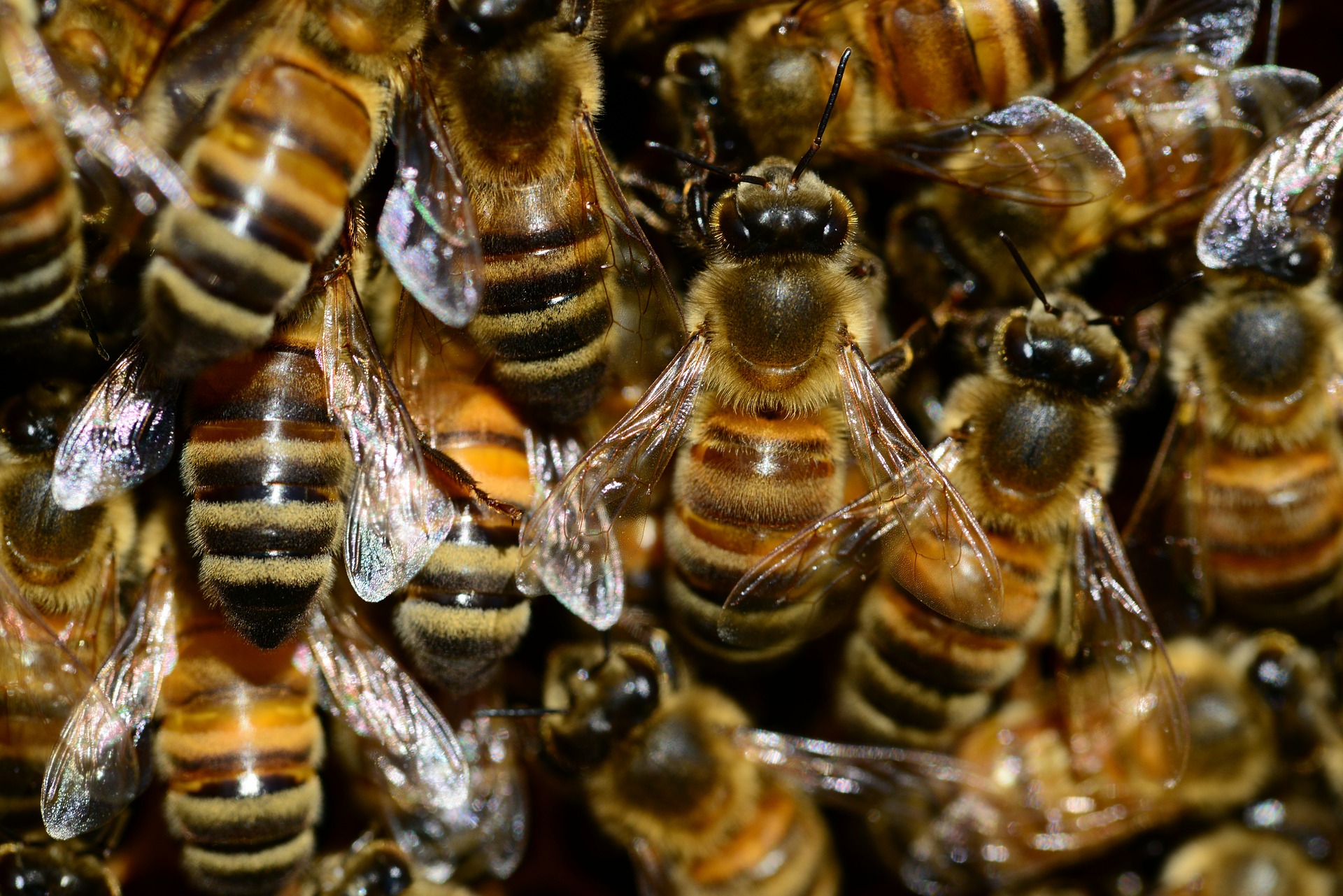
There's also the matter of honeycomb, which the bees make using wax produced in their abdomens. Each cell of the honeycomb is a perfectly identical hexagon, the most efficient shape which uses the least amount of wax and yet holds the most honey, to all of the others with which it interlocks. The cells slope downward by a small degree to prevent loss of honey.
Perhaps bees deserve a little more respect and a little less pilfering.
THREE... Bees need honey to survive.
Bees need honey. Without it, they die.
Bees work hard to make honey during the warm months to store for enough nourishment through the winter.
Honey, pollen, and nectar are bees' sole nourishment. They provide all of the micro and macro nutrients the bees need to live out their entire lives.
How can we justify taking away the vital nourishment of living creatures, for which they work tirelessly?
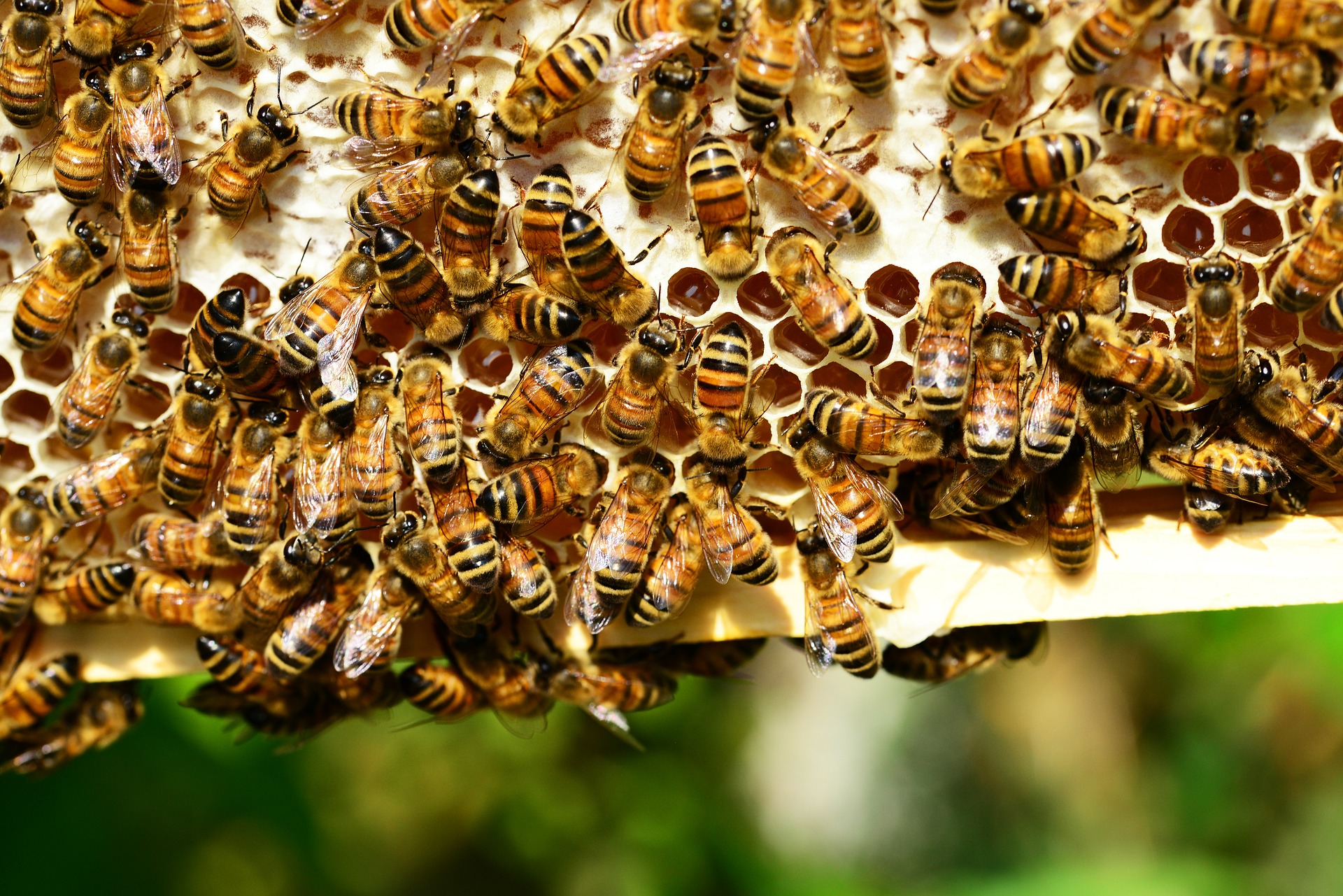
FOUR... Bees are being enslaved for human benefit.
Using slavery in the context of non-human animals can be controversial, but it is in my opinion the most accurate representation of what the human race is inflicting on billions of sentient beings on this planet.
'Slavery... refer(s) to involuntary subjection to another or others'
Why must this definition be interpreted to apply solely to humans?
Bees are not able to leave. Their freedom is restricted. They belong to a human. This is slavery.
There are those who suggest that if the bees wanted to leave they could just fly away, but this is an oversimplification of a complicated issue. Bees cannot survive on their own. They must be a part of a hive. A single worker bee who leaves her group and attempts to join another will likely be killed by the new group.
The population could split in half and attempt to leave (called swarming), but beekeepers do all they can to prevent this from happening by ripping off the wings of the queen so that she cannot leave and then killing her and replacing her with a younger queen before she would reach the age common for this behaviour.
Why don't they all leave together? Also not likely. It would be very difficult for a bee to understand the big picture of what is happening to them. To correctly associate individual events such as the sudden disappearance and replacement of the queen, the missing honey, or half of the hive being removed, with humans would be almost impossible.
Bees demonstrate their unhappiness with individual events by stinging beekeepers. But overall? How are they to know this isn't the natural order of things?
If these points aren't enough, beekeepers often trap the bees in their hive over the winter requiring them to remove large piles of dead bees a couple of times per season.
Let me get this straight, trapped in a cage with the dead and dying with no escape? Forced to work without being allowed to receive the benefits? Sounds like slavery to me.
FIVE... Stolen honey is replaced with a cheap substitute which has almost no nutritional value for the bees.
Yes, it's true. The stolen honey is replaced with a substitute of sugar or corn syrup. But how does it compare to honey in quality of nourishment?
Pretty poorly.
Honey is vitamin and nutrient rich, high in carbohydrates, and contains protein - the perfect food for bees.
Corn syrup? It contains far lower concentrations of the necessary micronutrients bees need to survive and no protein. It is simple sugar and that's it.
Beekeepers are starving their bees of nutrition all winter long so that humans can enjoy honey on toast.
That doesn't sound ethical to me.

SIX... Bees are often roughly handled and many die at the hands of keepers.
Most would cite their belief that bees can't feel pain as the reason why they don't worry about bee welfare. Unfortunately, there's a problem with that reasoning.
Because bees DO feel pain.
They are animals with large nervous systems and very capable of transmitting pain signals. And if that isn't enough to way you, scientific study has indicated that bees do, in fact, feel pain.
So now that we know that bees can be hurt, let's look at how beekeepers hurt them:
- Queens will often have their wings ripped off to prevent them from leaving the hive, as the workers will not make honey without a queen;
- Queen bees are killed after a year although they can live up to five;
- Bees, especially queens, are regularly shipped in the mail during which time they can easily be over heated, frozen, left to desiccate, jostled around violently, or exposed to insecticides;
- Queen bees are artificially inseminated;
- Entire hives are regularly killed off for the winter for economic benefit;
- Bees are often crushed in frames or stepped on;
- Their legs are torn off by pollen-collection trapdoors;
- Warming rooms, where the honeycomb is heated to ease honey removal, often have electric grids in the windows to kill stray bees.
So, bees feel pain. And they are subjected to pain on a regular basis.
But it's 'normal' to keep bees, right?
'In fact, if one person is unkind to an animal it is considered to be cruelty, but where a lot of people are unkind to animals, especially in the name of commerce, the cruelty is condoned and, once large sums of money are at stake, defended to the last by otherwise intelligent people.' - Ruth Harrison, author of Animal Machines
'The question is not, Can they reason? nor, Can they talk? but, Can they suffer?' - Jeremy Bentha
SEVEN... If the bees continue to die out, HUMANS WILL DIE. There are no ifs ands or buts about it.
Just like empty oceans would be catastrophic to the ecosystems of our planet, the extinction of bees would effectively eliminate 70% of all fruits, vegetables, nuts, and seeds on earth.
That means that not only would herbivores (vegetarians and vegans) go hungry, but all of the omnivores too as crops such as alfalfa, used widely to feed animals farmed for human consumption, would disappear.
Simply put, you don't want to live in a world without bees. Perhaps we should stop trying to control them and kill them off when it pleases us?
EIGHT... Honey is bee vomit. Literally.
Wait, what?
How do bees actually make honey?
- A bee will find a flower and use its proboscis (kind of like a tongue) to suck nectar from it;
- They store the nectar in their crop as they fly back to their hive, allowing enzymes to mix with the nectar;
- Once they arrive, they regurgitate (vomit) the nectar into the mouth of another bee;
- They will repeat this process several times, vomiting back and forth, until it is ready to be spit up into a honeycomb;
- At this time the bees will speed up the evaporation process by fanning the honeycomb with their wings;
- When most of the water is evaporated, the bee with seal the honeycomb with liquid secreted from their abdomen;
- This substance will eventually harden into beeswax.
So by now I'm sure you, being a reasonable person, have been convinced to stop eating honey. But what can you eat instead?
Alternatives to honey...


Honey is just one of many foods made by way of animal exploitation.
The situation looks bleak, but there is good news.
YOU can make a difference! Share this infographic and spread the word - eating honey is not ethical in any way. Say no to honey and let's save the bees!

Until next time,

SOURCES & FURTHER READING/WATCHING
- Watch this GREAT video by Bite Size Vegan, awesome for kids!
- http://plantbasedbride.com/blog/ten-reasons-to-go-vegan
- http://www.livescience.com/37611-what-is-honey-honeybees.html
- https://ealingbees.wordpress.com/inside-the-hive/why-do-bees-make-honey/
- http://www.vegetus.org/honey/swarming.htm
- http://www.vegetus.org/honey/honey.htm
Happy Veganniversary to Me!
Today marks the beginning of my 4th year as a vegan!
1,095 days as a vegan has taught me a lot, and I thought I would take this opportunity to share my 4 top tips for living a purposeful and happy vegan life!
Today marks the beginning of my 4th year as a vegan!
1,095 days as a vegan has taught me a lot, and I thought I would take this opportunity to share my top 4 tips for living a purposeful and happy vegan life!

ONE... Sriracha and nutritional yeast are your friends.
Feel free to use liberally.
Feel no shame.

TWO... Don't let anyone steal your spark.
I mean this in both a specific and more broad be-your-own-majestic-unicorn sense.
Specifically, in relation to veganism, don't let anyone make you feel guilty for your choices. You are doing immeasurable good for the welfare of animals, your health, and the environment. Don't feel you ever have to apologize for that. People will try to tear you down. That's the unfortunate truth. But you're doing your best to leave a positive impact on the world, and if that makes other people feel bad, that's not your problem.
I understand that vegans tend to be sensitive people. Plants know, I am. But don't let the haters give you a heavy heart or make you a stereotype of 'the angry vegan'. Be proud of who you are, of what you're doing. Be passionate. You deserve to be!
THREE... Know your facts.
The more you know about the realities of animal agriculture, plant based nutrition, and ethics the easier your life as a vegan will be.
When someone criticizes or questions your way of life, the easiest way to diffuse the situation is to educate. If you really know your stuff, it becomes much harder to argue against.
Be kind and understanding but don't back down on the facts. Truth is truth, no matter how much people try to deny it. Eventually the facts will add up.
That's exactly why I started this blog, to simultaneously educate omnivores, vegetarians, and fellow vegans! I wanted a place to record the information I have been continuously learning over the past 3+ years where it could benefit more than just myself.
If you really don't know where to start, go to this page and download the vegan 101 booklet I created for just that - quick, easily digestible facts on the main facets of the vegan lifestyle. (It's free! Just scroll down a bit to the green box.) You can even print it out and carry it around with you for reference when you need it or save it to your phone!
Empower yourself and take charge of your interactions with others. As much as we might dislike the responsiblity, we may be the only vegan this person has ever met. You, at some time or another, will represent all vegans. So know your stuff!
FOUR... Have fun with it!
Being vegan isn't all about doom and gloom. Yes, the world is in a frightening state. Yes, there is much to be sad and angry about. Yes, change is coming far too slow.
But if you focus on these things too much, they will take over your life. And not in a good way. (Believe me, I know.)
Activism is important. Every kind of activism has its place. And there's no rule saying you have to stick to one kind of activism for your entire life.
Feeling particularly riled up? Go protest or participate in a demonstration! Yell until you lose your voice!
Feeling more grounded and at peace? Take time to connect with people about these issues one on one. Have deep, meaningful conversations.
Feeling inspired to cook glorious vegan foods? Do it - and share widely!
Veganism is about being compassionate to all sentient beings. And guess what... that includes you. Don't neglect to show yourself compassion. We need as many strong, happy, fulfilled vegans as possible to bring about the changes that are sorely needed.
Don't forget to be one of them.
How long have YOU been vegan, vegetarian, or veg-curious?
I want to know!
Until next time,

Coined by Elizabeth Jean @xparmesanprincessx, the personal curriculum trend is about creating a self-directed learning plan focused on areas of personal interest, loosely based on a school curriculum structure, including things like assigned reading, goals, assignments, and final projects.
At its core, the personal curriculum movement is about celebrating lifelong learning and intellectual curiosity. It's about being more intentional about how we spend our time when we're not sleeping, or at work, or doing the basic maintenance or admin or chores to keep our lives going. It's about using our free time to enrich our lives in a way that is purposeful and intentional and joyful, indulging our curiosity as adults, even once we're outside of structured school environments, getting excited about learning and allowing ourselves the freedom to go down those rabbit holes in our special interests, to challenge our brains in ways that we maybe don't get the chance to in our day-to-day lives.