

the blog.
Non Vegan Ingredients to Avoid
Whether you're a new vegan or a vegan veteran, keeping track of no-no ingredients can be incredibly difficult. Friends and family, from longer term vegans all the way to new vegetarians, have been lamenting hidden animal ingredients popping up all over the place in the foods they used to enjoy with a clean conscience. That's why I'm creating this handy guide! Pin or bookmark it so that you can come back and use it as a reference while shopping, making your life that much easier. These ingredients may be found in food, personal care products, clothing, household products, and more. Remember: no one is perfect and it's impossible to successfully avoid all of these ingredients 100% of the time. Don't beat yourself up or get too caught up in the purity of it all and just do your best!
Whether you're a new vegan or a vegan veteran, keeping track of no-no ingredients can be incredibly difficult. Friends and family, from longer term vegans all the way to new vegetarians, have been lamenting hidden animal ingredients popping up all over the place in the foods they used to enjoy with a clean conscience. That's why I'm creating this handy guide! Pin or bookmark it so that you can come back and use it as a reference while shopping, making your life that much easier. These ingredients may be found in food, personal care products, clothing, household products, and more. Remember: no one is perfect and it's impossible to successfully avoid all of these ingredients 100% of the time. Don't beat yourself up or get too caught up in the purity of it all and just do your best!

A
- Adrenaline - derived from the adrenal glands of pigs, cows, or sheep.
- Albumen/Albumin - derived from eggs.
- Allantoin (also Alcloxa and Aldioxa) - derived from cow urine.
- Alligator Skin
- Alpha-Hydroxy Acids - may be lactic acid, which can be animal derived.
- Ambergris - derived from whale intestines.
- Amino Acids (alanine, - may be animal derived.
- Angora - hair from rabbits or goats.
- Animals Fats and Oils
- Animal Hair
- Arachidonic Acid - derived from the liver, brain, glands, and fat of animals.
- Arachidyl Proprionate - may be derived from animal fat.
B
- Bee Pollen
- Bee Products
- Beeswax
- Beta Carotene - may be derived from animal sources.
- Biotin, Vitamin H, and Vitamin B Factor - found in every living cell, often derived from milk or yeast.
- Blood
- Boar Bristles - boar hair.
- Bone Char - animal bone ash.
- Bone Meal - crushed or ground animal bones.
- Butter, Artificial Butter, Artificial Butter Flavour, Butter Extract, Butter Fat, Butter Flavoured Oil, Butter Solids, Dairy Butter, Natural Butter, Natural Butter Flavour, Whipped Butter
- Buttermilk, Buttermilk Blend, Buttermilk Solids
Related Post: 25 Surprising Non-Vegan Foods
C
- Calfskin
- Caprylamine Oxide, Capryl Betaine, Caprylic Triglyceride and Caprylic Acid - derived from cow's or goat's milk.
- Carmine, Carminic Acid, and Cochineal - derived from crushed female cochineal insects.
- Carotene and Provitamin A - may be derived from animal sources.
- Casein, Caseinate, and Sodium Caseinate - milk protein.
- Cashmere - wool of the Kashmir goat.
- Castor and Castoreum - may be derived from muskrat and beaver genitals. (Synthetics widely used.)
- Catgut - derived from the intestines of sheep, horses, and other animals.
- Cera Flava - derived from bees.
- Cerebrosides - may be derived from the brains of animals.
- Cetyl Alcohol, Cetyl Palmitate - may be derived from sperm whales and dolphins. (Synthetics widely used.)
- Cheese, Cheese Flavour (artificial and natural), Imitation Cheese
- Chitosan - derived from the shells of crustaceans.
- Cholesterol - derived from animal fat, nerve tissue, animal nerve tissue, egg yolks, and blood.
- Civet - derived from a gland near the genitals of civet cats.
- Collagen - usually derived from animal tissue.
- Colours and Dyes - may be of animal origin.
- Confectioner's Glaze - contains approximately 35% shellac (see below).
- Cortisone, Hydrocortisone, and Corticosteroid - may be derived from the adrenal glands of animals. (Synthetics widely used.)
- Cream, Whipped Cream
- Curds
- Custard
- Cysteine, L-Form - may be derived from animal hair.
- Cystine - an amino acid found in urine and horsehair.
D
- Dairy, Dairy Product, Dairy Product Solids
- Down - goose or duck insulating feathers.
- Duodenum Substances - derived from the digestive tracts of cows and pigs.
E
- Eggs
- Egg Protein
- Elastin - derived from the neck ligaments and aortas of cows.
- Emu Oil - derived from factory-farmed emu.
- Estrogen and Estradiol - derived from the urine of a pregnant mare.
F
- Fats and Fatty Acids - derived from animals.
- Feathers - plucked from birds.
- Fish Oil, Fish Liver Oil, and Cod Liver Oil - derived from marine animals.
- Fish Scales
- Fur
G
- Gelatin, Gel, and Hide Glue - protein derived from the skin, tendons, ligaments, and/or bones of cows and pigs.
- Ghee - a form of butter used in Indian cooking
- Glycerin, Glycerol, Glyceryls, Glycreth-26, Polyglycerol, and Glycerides - normally derived from animal fat.
- Guanine - derived from the scales of fish.
H
- Half & Half
- Honey and Honeycomb
- Horsehair
- Hyaluronic Acid - can be derived from umbilical cords and the fluids around the joints of animals.
- Hydrolyzed Animal Protein - derived from animals.
Related Post: 10 Reasons To Go Vegan!
I
- Insulin - derived from hog pancreas.
- Isinglass - a form of gelatine derived from fish bladders.
K
- Kefir - made using milk.
- Keratin - protein derived from ground-up horns, hooves, feather, quills, and hair or animals.
L
- Lactic Acid - can be derived from blood and muscle tissue.
- Lactose, Galactose, Lactate Solids, Lactic Yeast, Lactic Monohydrate, Lactoferrin, Lactoglobulin, Lactulose, Lactalbumin, Lactalbumin Phosphate - derived from the milk of mammals.
- Lanolin, Laneth, Lanogene, Lonolin Acids, Wool Fat, Wool Wax, Lanolin Alcohol, Lanosterols, Isopropyl Lanolate, Cholesterin, Aliphatic Alcohol, and Amerchol L101 - extracted from sheep's wool.
- Lard - fat derived from hog abdomens.
- Leather
- Lecithin and Choline Bitartrate- often obtained from eggs and soybeans.
- Linoleic Acid - an essential fatty acid derived from fatty acids.
- Lipase - derived from the stomachs and tongue glands of calves, kids, and lambs.
- Lipids, Lipoids - derived from animals and plants.
M
- Marine Oil - derived from fish and marine mammals.
- Methionine - usually derived from eggs and milk.
- Milk, Acidophilus Milk, Cultured Milk, Condensed Milk, Dried Milk, Dry Milk Solids (DMS), Evaporated Milk, Lactose-Free Milk, Malted Milk, Milk Derivative, Milk Powder, Milk Protein, Milk Solids, Pasteurized Milk, Powdered Milk, Sour Milk
- Mink Oil - derived from minks.
- Monoglycerides and Diglycerides - derived from animal fat.
- Musk Oil - secretion derived from musk deer, beaver, muskrat, civet cat, and otter genitals.
- Myristic Acid, Myristyls, and Myristal Ether Sulfate - occassionally derived from animals.
N
- Natural Sources - can come from plant or animal sources.
- Nisin, Nisin Preparation - derived from milk.
- Nougat - often contains egg and honey.
- Nucleic Acids - derived from the cells of plants or animals.
O
- Octyl Dodecanol - derived from animal sources.
- Oleic Acid - obtained from animal or vegetable fats.
- Oleyl Alcohol, Ocenol, Oleths, Oleyls - derived from fish.
P
- Palmitic Acid, Palmitamide, Palmitamine, Palmitate - commonly derived from palm oil, but also from animal sources.
- Panthenol, Dexpanthenol, Vitamin B-Complex Factor, Provitamin B-5, Panthenyl - can come from animal, plant, or synthetic sources.
- Pepsin - derived from hog stomachs.
- Placenta - derived from the uterus of dead animals.
- Polypeptides - derived from animal protein.
- Polysorbates - derived from animal fatty acids.
- Pristane - derived from the liver oil of sharks and whales.
- Progesterone - a hormone derived from animals.
- Propolis - derived from beehives.
- Pudding
Q
- Quark - a soft cheese.
R
- Recaldent - derived from milk.
- Rennet, Rennet Casein, Rennin - enzyme derived from calves' stomachs.
- Retinol - vitamin A derived from animals.
- RNA (Ribonucleic Acid) - can be derived from animal or plant cells.
- Royal Jelly - a secretion from the throat glands of bees.
Related Post: 15 Weird Things I Do Now That I'm Vegan
S
- Sable Brushes - made from the fur of sables (similar to weasels).
- Shark Liver Oil and Squalane - derived from sharks.
- Sheepskin
- Shellac and Resinous Glaze - derived from insect excretions.
- Silk and Silk Powder - obtained from silk worms.
- Snails
- Sour Cream, Sour Cream Solids, Imitation Sour Cream
- Sperm Oil and Spermaceti - mostly derived from petroleum, but also derived from the heads of sperm whales and dolphins.
- Sponge - a plant-like marine animal.
- Stearic Acid, Stearamide, Stearamine, Stearamine Oxide, Stearates, Stearic Hydrazide, Stearone, Stearoxytrimethylsilane, Stearoyl Lactylic Acid, Stearyl Acetate, Dimethyl Stearamine and Isopropyl Palmitate - can be derived from cows, pigs, sheep, and cats and dogs euthanized in animal shelters.
- Stearyl Alcohol, Sterols, Stearyl Caprylate, etc. - may be prepared from sperm whale oil.
- Steroids and Sterols - can be derived from animal glands or plant sources.
- Suede
- Sugar - often refined using bone char
T
- Tallow, Tallow Fatty Alcohol, Sodium Tallowate, Tallow Acid, etc. - rendered beef fat.
- Turtle Oil and Sea Turtle Oil - derived from the muscles and genitals of giant sea turtles.
- Tyrosine - can be derived from milk.
U
- Urea, Uric Acid - typically synthetic, can be derived from the urine of animals and other bodily fluids.
V
- Vitamin A - can come from fish liver oil, egg yolk, butter, and plant and synthetic sources.
- Vitamin B12 - can come from animal products or bacteria cultures.
- Vitamin D, Provitamin D-2, Ergocalciferol, Ergosterol, Vitamin D2, Calciferol, Vitamin D3 - can be derived from animal or plant sources.
W
- Wax - derived from both animal and plant sources.
- Whey, Acid Whey, Cured Whey, Delactosed Whey, Demineralized Whey, Hydrolyzed Whey, Powdered Whey, Reduced Mineral Whey, Sweet Dairy Whey, Whey Protein, Whey Protein Concentrate, Whey Powder, Whey Solids - a serum from milk.
- Wool - derived from sheep.
Y
- Yogurt
Notice something I missed? Let me know in the comments and I'll add it! I will continue to update this post as I find new ingredients that are animal-derived so that we can all work on making our lives as animal-product free as possible, together!
Until next time,













15 Weird Things I Do Now That I'm Vegan
In the interest of transparency, I feel it's important to mention that I've always been weird. This isn't some kind of new thing. Just ask Jason. I'm an introvert, but when you get to know me well? All bets are off! I'm an incredibly opinionated and creative person, and like what I like no matter how "weird" or "nerdy" other people may think those things are. I make big expressive faces and voices, love to sing all day long, and love Doctor Who. And while it may seem that there isn't much room for more weirdness from there, I definitely got weirder when I went vegan. Much weirder. Keep reading as I confess all and tell you the 15 weird things that I've started doing since going vegan!
I got the idea for this post from Matt Frazier of No Meat Athlete on his podcast. Check it out here!

In the interest of transparency, I feel it's important to mention that I've always been weird. This isn't some kind of new thing. Just ask Jason. I'm an introvert, but when you get to know me well? All bets are off! I'm an incredibly opinionated and creative person, and like what I like no matter how "weird" or "nerdy" other people may think those things are. I make big expressive faces and voices, love to sing all day long, and love Doctor Who. And while it may seem that there isn't much room for more weirdness from there, I definitely got weirder when I went vegan. Much weirder. Keep reading as I confess all and tell you the 15 weird things that I've started doing since going vegan!
ONE I sometimes go an entire day only eating bananas.
Not only that, but I like 'em good and spotty.
TWO I read the ingredient list on everything. Twice.
Food? I read the ingredient list. Toothpaste? I read the ingredient list. Clothes? I read the materials list. All day long, every day.
THREE I spend exorbitant amounts of time reading books, watching documentaries, listening to podcasts, and watching you tube videos about veganism, nutrition, animal rights, and the environment.
I am on a constant hunt for more information about the vegan lifestyle and the state of our planet. All of my curiosity and interest that was fostered in school has been transferred to this one, infinitely fascinating, interrelated group of subjects.
FOUR I eat sriracha on everything.
Mushrooms, rice cakes, pita bread, rice, pasta, tofu scramble, salad... you name it, I'll sriracha it.
FIVE I love tempeh, tofu, and seitan.
And other things that make my parents go "Huh?"
SIX I eat huge portions, especially of fruit and salad!
That family size salad bowl? I'll have two, thanks. One apple for breakfast? Uh... no. How about 5.
SEVEN I cross the street to avoid shops with meat in the window.
And I don't shop at grocery stores with lots of animal flesh on display. It's gross and upsetting and smells horrific.
EIGHT I bring food with me pretty much everywhere.
Tupperware full of beans and rice? Check. A bunch of bananas? Check. Rice cakes and a mini bottle of sriracha? Double check!
NINE I love green smoothies with odd ingredients!
The more gross it sounds to the average Joe, the more I want it in my belly.
TEN I can order off the average menu in less than a minute, but it takes me forever to decide at a vegan restaurant.
What? I have more than one option that needs to be modified by removing half of the ingredients to be vegan? This is going to take a while...
*30 minutes later*
I'll get the Tempeh Quinoa bowl. Wait! No, the Mushroom Risotto. But what about the soup!
*another 20 minutes later*
IDON'TKNOW...AHH...How do normal people do this everyday??
ELEVEN I love salad without salad dressing.
Give me all them raw, plain veggies!
TWELVE I can talk about veganism for hours and hours and still have more to say.
And that's why I started this blog. (Duh.)
THIRTEEN I've become a bit of a hermit.
I avoid situations in which I'll be around lots of animal products. It's hard to have fun when you're surrounded by dead flesh. Or is that just me?
FOURTEEN I use coconut oil for everything.
It's figuratively a miracle!
FIFTEEN I dislike almost all junk food.
Seriously. All I want is fresh produce all day everyday.
And there you have it. The 15 ways I'm weirder than I was two and a half years ago. And that's really saying something!
Until next time,

What weird things did you start doing when you went vegan? I want to hear them all! Write to me in the comments below or on social media.
Don't forget to subscribe to the plant based bride newsletter at the bottom of this page. It's fun!




Why I Add a B12 Supplement To My Vegan Diet
If you've spent any time in the vegan community online, it's likely you've heard talk about B12. But what is B12 and why do we need it? Do you need to use supplementation, or is it readily available in the foods we eat? What happens if we don't get enough or get too much? Do only vegans have to worry about their B12 levels? Read on to learn the answers!
If you've spent any time in the vegan community online, it's likely you've heard talk about B12. But what is B12 and why do we need it? Do you need to use supplementation, or is it readily available in the foods we eat? What happens if we don't get enough or get too much? Do only vegans have to worry about their B12 levels? Read on to learn the answers!

What is B12?
B12 is a vitamin that is essential for human health, used by the body to make new blood cells and DNA. It is also a component of the myelin sheath, the protective layer of our nerves which also helps to conduct messages. B12 is made by anaerobic microorganisms (bacteria that don't require oxygen).
How much B12 do I need?

Where is B12 found in nature?
In today's food supply, B12 is only really found in animal products (meat, milk and eggs) and fortified foods. Certain varieties of mushroom and fermented foods contain B12, but in very small quantities insufficient to reach human needs. Plants grown in B12 rich soil (which is unfortunately very uncommon today) easily absorb B12 and there is some B12 in certain varieties of algae (although not in its active form) and therefore both options are not particularly useful for our purposes.
How do animals get their B12?
Certain animals such as cows and sheep get most of their B12 by absorbing it as it is made by their gut bacteria. All animals get a portion of their B12 intake from the following sources:
- The consumption of feces;
- Bacterial contamination of their food, and;
- The consumption of animal flesh, milk, and eggs.
What are the symptoms of B12 deficiency?
There are four stages of B12 deficiency:
Stage I: Declining blood levels of B12
Stage II: Low cellular concentrations of B12
Stage III: Increased homocysteine in the blood and a decreased rate of DNA synthesis
Stage IV: Macrocytic anemia.
Many undesirable symptoms come along with low levels of B12, even before you reach the final stage of B12 deficiency: anemia. These symptoms include:
- Fatigue;
- Lethargy;
- Weakness;
- Numbness in the hands, legs, or feet;
- Neurological problems such as memory loss and cognitive difficulties;
- Difficulty walking;
- Shortness of breath;
- Palpitations;
- Pallor;
- A swollen tongue;
- Jaundice, and;
- Psychiatric problems such as paranoia or hallucinations.
How can I ensure I get enough B12?
If you are eating the standard american diet you are probably getting more than you need daily, but if you fall within one of the following categories you may need to look into supplementation:
- Over 50 years old;
- Vegan;
- Taking medications that interfere with the absorption of B12; or
- Suffering with the malabsorption of foods due to weight-loss surgery or a medical condition.
While many foods are fortified with B12, these are likely insufficient for the needs of the above groups. I, personally, take a B12 supplement daily in the form of a sublingual spray to ensure adequate intake. For most, the smallest available dose of B12 (usually 100 mcg) taken daily does the trick. Only a small percentage of that will be absorbed due to the body's limited ability to absorb B12 at amounts larger than about 4 mcg at any given meal. Luckily, 4 mcg of B12 daily is more than anyone should require, unless struggling with absorption. I know what you're thinking, but no. Higher doses of B12 aren't necessarily better. While there are no known negative health effects of more B12 in the body, the percentage of B12 absorbed is actual reduced when larger doses are taken.
You might also like: Vegans vs Protein and Building Strong Bones With Plants
What kind of B12 supplement should I take?
Any kind works, but it has been found that tablets that you chew or dissolve in the mouth, and sprays that you hold in your mouth for a certain period of time, are better absorbed than pills.
Should I get my B12 checked?
Through my research I've found a common recommendation from physicians to have B12 and methylmalonic acid (MMA) levels checked every few years, but only for those who are at a higher risk of deficiency.
For the general population, B12 deficiency is not a big concern. For vegans and vegetarians, however, it remains a real risk with as many as 50-80% suffering from the deficiency. I am an advocate for a healthy vegan diet, and find that I receive adequate amounts of every conceivable nutrient without the need for supplementation, with the exception of B12. I myself take a daily supplement and recommend that any vegans out there do the same!
Until next time,

Do you take a B12 supplement? What are your thoughts on supplementation in general? Let me know in the comments below!
Feel free to join the plant based bride community in the form at the bottom of this page for updates and freebies!
Sources and Further Reading
https://ods.od.nih.gov/factsheets/VitaminB12-Consumer/
http://chriskresser.com/b12-deficiency-a-silent-epidemic-with-serious-consequences/
http://www.dietitians.ca/Downloads/Factsheets/Food-Sources-of-Vitamin-B12.aspx
http://nutritionstudies.org/12-questions-answered-regarding-vitamin-b12/
http://www.eatrightontario.ca/en/Articles/Nutrients-(vitamins-and-minerals)/What-you-need-to-know-about-vitamin-B12.aspx#.Vfh_gLTPmfQ
http://www.health.harvard.edu/blog/vitamin-b12-deficiency-can-be-sneaky-harmful-201301105780
http://plenteousveg.com/algae-b12/
http://patient.info/doctor/macrocytosis-and-macrocytic-anaemia






Why Going Pescatarian Doesn't Cut It
Often when someone finds out that I'm a vegan they're quick to justify their own choices. "I'm basically a vegetarian, but I NEED bacon!" or "I only eat white meat." or "I'm a vegetarian, but I eat fish." I've always found this last one to be one of the oddest in the bunch. Really, it's the entire "pescatarian" trend that confuses me. Why distinguish between the flesh of sea and land animals? If you avoid the meat of cows and pigs and chickens and turkeys for health or ethical or environmental reasons, why wouldn't you also avoid fish? It seems to me that just like most people have trouble seeing the animals we raise for livestock in the same light as the animals we keep as pets, the majority view fish as living beings lower on the ladder of importance than mammals, and therefore less like us (and less deserving of life). Most of you would NEVER eat a dolphin. But tuna? Why not? I think a big part of this pervasive belief is that people don't fully understand the impact commercial fishing has on our planet and health. Luckily for you, I'm here to fill you in!
Often when someone finds out that I'm a vegan they're quick to tell me about all about their diet. "I'm basically a vegetarian, but I NEED bacon!" or "I only eat white meat." or "I'm a vegetarian, but I eat fish." and the list goes on. I've always found this last one to be one of the oddest in the bunch. Really, it's the entire "pescatarian" trend that confuses me. Why distinguish between the flesh of sea and land animals? It seems to me that if you avoid the meat of cows and pigs and chickens and turkeys for health or ethical or environmental reasons, you would also avoid fish for the exact same reasons. It's clear that just like most people have trouble seeing the animals we raise for livestock in the same light as the animals we keep as pets, the majority view fish as living beings lower on the totem pole than mammals. For most people this ultimately means that fish are just that much more different than us and are therefore less deserving of life. Most of you would NEVER eat a dolphin. But tuna? Why not? I think a big part of this pervasive belief is that people don't fully understand the impact commercial fishing has on our planet and health. Lucky for you, I'm here to fill you in!
Modern day fishing is nothing like the fishing of old. Today, if you want to eat tuna salad for every meal, you can. The big plus? You don't have to catch the fish yourself! Eating fish has become incredibly convenient. But at what cost? Last year more than 28 billion animals were pulled out of the oceans. Twenty eight billion. Many of those animals were not even the targeted species, but a collection of all other living creatures in the area, termed "by catch".
Fishing is, in fact, the primary cause of loss of species in our time. Animals are being removed from our oceans faster than they can possibly reproduce. According to the National Oceanic and Atmospheric Administration, there are approximately 2,215 species of animal listed as endangered or threatened under the Endangered Species Act. This list includes many marine animals such as:
- two species of dolphin;
- thirteen species of whale, including sperm, blue, killer, and beluga;
- six varieties of turtle;
- six species of seal;
- and fifty seven species of fish including trout, sturgeon, hammerhead shark, and salmon.
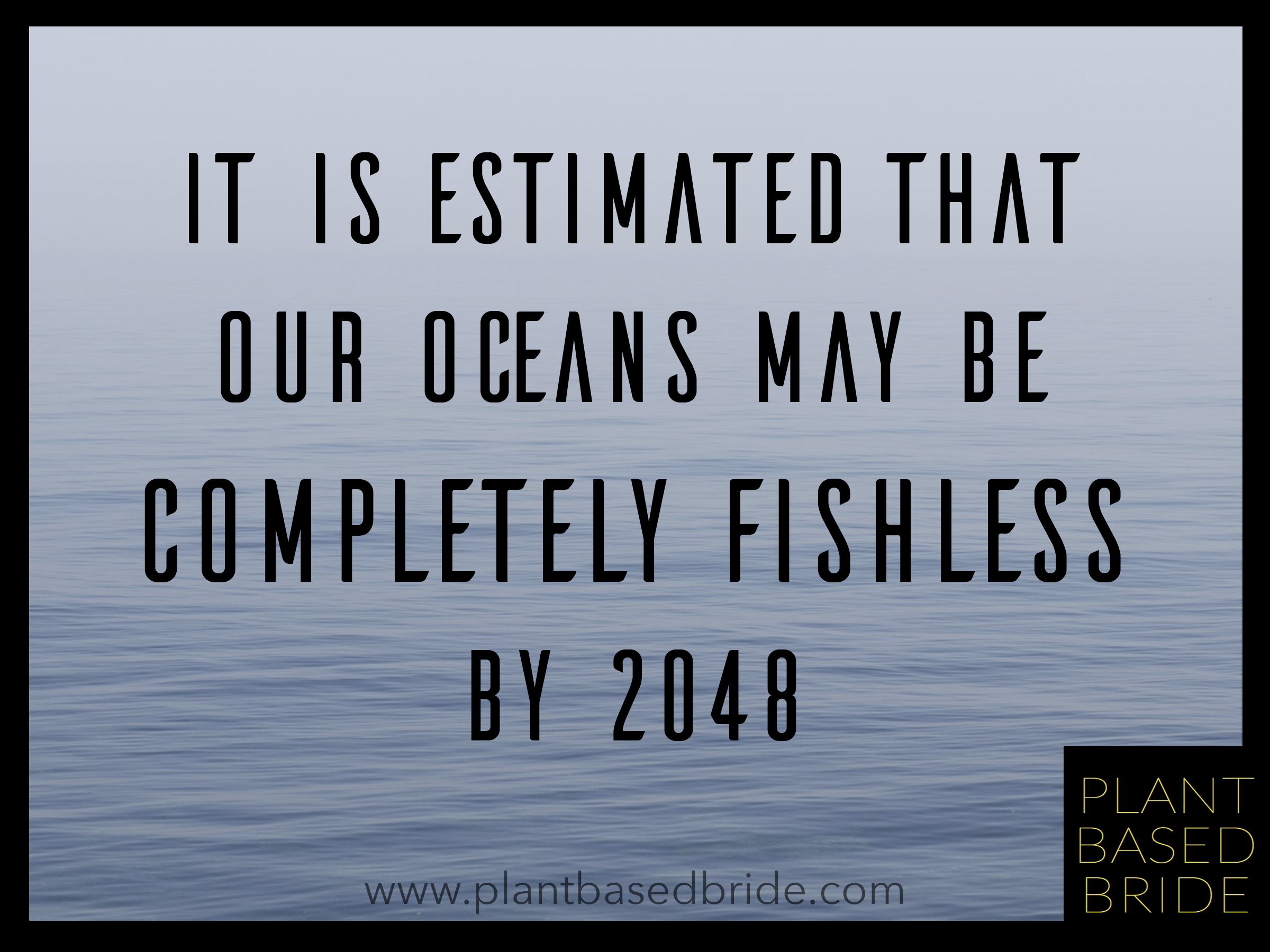
Fishing not only causes serial depletion (depleting species A, moving on to species B, depleting species B, moving on to species C, depleting species C, and so on) but destroys the aquatic environment and kills many other species as by-kill. The oceans are nearing complete collapse with many large fish species nearing extinction, with 90% of our oceans' large fish species having already gone extinct in the past 50 years. It is estimated that our oceans may be completely fishless by 2048. That's right, our oceans may be empty of life in a mere 33 years. I want my grandchildren to experience swimming with the fishes, don't you?
So how come fishing is causing so many non-targeted animals to be killed as by-kill? To understand this, you need to understand how commercial fishing is done.
Long-lines are lines as long as 75 miles covered in hundreds of thousands of baited hooks. While some animals drown or bleed to death in the water, the majority remain alive and struggling until they are reeld into the boat to their slaughter. Each year billions of animals including sharks, sea turtles, birds, and dolphins are injured or killed by long-lines.
Gill Nets ("walls of death") are huge nets ranging in size from 200 feet to more than a mile long which are weighted at the bottom and floated at the top, then left unmonitored for days at a time. The sharp mesh is difficult to see and all but the smallest fish get stuck. If they try to back out the mesh catches them by the gills or fins causing them to suffocate, and if they struggle too violently they will often bleed to death. Any fish who remain alive once on deck are ripped out of the net by hand and suffocate or cut open while still living. Deep sea fish often suffer from decompression, meaning that the change in pressure is so extreme that their stomachs are forced out of their mouths.
Purse Seines are under fire for sometimes catching dolphins in the nets, but are usually intended to catch tuna. Fishers track pods of dolphins, commonly found swimming with tuna, and drop a net to surround the school. The edges of the net are slowly cinched together trapping hundreds of tuna. These fish are almost all conscious when their gills are slit and they are disemboweled.
Bottom trawlers are pretty much what they sound like. These large bag-like nets are dragged across the ocean floor, picking up everything in their path. And by everything, I mean every fish, mammal, stone, and plant. Metal plates on each end weigh down the net and stir up sediment to force fish into it. This method of fishing turns the ocean floor into a clean slate, and not in a good way. Bottom trawling is extremely similar to clear-cutting a forest. These nets can hold hundreds of tons of animals at one time, sometimes crushing them so strongly between each other and the net that their eyes pop out. Fish are dragged along the ocean floor with rocks, coral, and debris for hours, grinding their scales off. Any fish left alive when they are brought to the surface will experience the same agonizing decompression I described earlier.
As you can see, not only is commercial fishing bad for the species we are hoping to catch (those survivors who don't have their gills cut while still alive to bleed to death are put on ice to slowly freeze or suffocate, a process which takes a very long time for cold-blooded animals like fish. It is estimated that it takes up to 15 minutes of intense pain before most fish lose consciousness.) but also for the nearly 1,000 marine mammals who are caught daily as by-catch and thrown back into the water to be killed by swarming birds or bleed to death, if they hadn't already died due to the torture they were subjected to.
Fish and Your Health
As if these environmental reasons weren't enough to discourage anyone from eating fish, it also has numerous ill effects on your health. It is advised that pregnant women and children completely avoid those species of fish that have been found to contain high levels of mercury due to their negative impact on developing nervous systems as well as their accelerating effect on arthrosclerosis (a hardening of the arteries which leads to heart attacks and strokes). Fish also contain PCBs and dioxins which have been linked to cancer and reproductive problems and are a major cause of food-borne illness.
Fish is made up of as much as 60% fat, which contributes to obesity and diabetes. Fish also contains cholesterol, at an even higher proportion of cholesterol per calorie than red meat. Fish contains substantial amounts of animal protein, which as we now know, contributes to bone loss and osteoporosis. In fact, the Inuits (widely known to consume the highest percentage of fish in their diet in the world) have the highest rates of osteoporosis on the planet. It has been found that both male and female Inuits have anywhere from 10-15% higher bone loss than those of Caucasian descent in the United States of the same age. This is despite a consumption of up to 2,500 mg of calcium a day (a majority of which comes from fish bones).
You might also like: Building Strong Bones With Plants and Should You Worry About Your Body's pH?
What about fish oil supplements?
Fish oil supplements cause LDL (the bad cholesterol) to rise in those that take it, even in those supplements which have had the cholesterol removed through purification. It was found in one study that fish oil treatment did not promote favourable changes in atherosclerotic coronary arteries' diameters, even after 2 years. Fish oil has another less than desirable effect: it supresses our immune system. As you know, a suppressed immune system is less able to fight of infections and diseases, including cancer. Fish oil has also been found to cause severe bleeding.
All in all, it's clear to see that not only is choosing to eat fish a choice to diminish our health but a choice to corroborate in the torture and slaughter of billions of intelligent, feeling, animals every single year. Going pescatarian isn't the path towards health, it's the path towards death; for us and our planet's aquatic life. I don't eat fish because I want to live a long, healthy life in which visits to the ocean include marine life sightings, rather than swimming in a glorified pool, devoid of living things. What does eating fish do for you that is so great it outweighs the harm? I think you'll find with a bit of reflection that the answer is: "Nothing."
Until next time,

What are your thoughts on the fishing industry? Join the conversation below and on social media! (Use the hashtag #plantbasedbride so I can find your posts and tag me, @elizabethturn, on instagram and twitter!)
Don't forget to subscribe to the Plant Based Bride newsletter to be notified when new posts are published, get news & updates, and receive a FREE goal setting printable to go along with my 5 Steps for Setting Great Goals blog post!
Further Reading & Sources
http://www.earthsave.org/news/03summer/fish.htm
http://www.consumerreports.org/cro/2012/08/the-benefits-and-risks-of-eating-fish/index.htm
http://www.peta.org/issues/animals-used-for-food/factory-farming/fish/commercial-fishing/


Coined by Elizabeth Jean @xparmesanprincessx, the personal curriculum trend is about creating a self-directed learning plan focused on areas of personal interest, loosely based on a school curriculum structure, including things like assigned reading, goals, assignments, and final projects.
At its core, the personal curriculum movement is about celebrating lifelong learning and intellectual curiosity. It's about being more intentional about how we spend our time when we're not sleeping, or at work, or doing the basic maintenance or admin or chores to keep our lives going. It's about using our free time to enrich our lives in a way that is purposeful and intentional and joyful, indulging our curiosity as adults, even once we're outside of structured school environments, getting excited about learning and allowing ourselves the freedom to go down those rabbit holes in our special interests, to challenge our brains in ways that we maybe don't get the chance to in our day-to-day lives.