

the blog.
Why I Add a B12 Supplement To My Vegan Diet
If you've spent any time in the vegan community online, it's likely you've heard talk about B12. But what is B12 and why do we need it? Do you need to use supplementation, or is it readily available in the foods we eat? What happens if we don't get enough or get too much? Do only vegans have to worry about their B12 levels? Read on to learn the answers!
If you've spent any time in the vegan community online, it's likely you've heard talk about B12. But what is B12 and why do we need it? Do you need to use supplementation, or is it readily available in the foods we eat? What happens if we don't get enough or get too much? Do only vegans have to worry about their B12 levels? Read on to learn the answers!

What is B12?
B12 is a vitamin that is essential for human health, used by the body to make new blood cells and DNA. It is also a component of the myelin sheath, the protective layer of our nerves which also helps to conduct messages. B12 is made by anaerobic microorganisms (bacteria that don't require oxygen).
How much B12 do I need?

Where is B12 found in nature?
In today's food supply, B12 is only really found in animal products (meat, milk and eggs) and fortified foods. Certain varieties of mushroom and fermented foods contain B12, but in very small quantities insufficient to reach human needs. Plants grown in B12 rich soil (which is unfortunately very uncommon today) easily absorb B12 and there is some B12 in certain varieties of algae (although not in its active form) and therefore both options are not particularly useful for our purposes.
How do animals get their B12?
Certain animals such as cows and sheep get most of their B12 by absorbing it as it is made by their gut bacteria. All animals get a portion of their B12 intake from the following sources:
- The consumption of feces;
- Bacterial contamination of their food, and;
- The consumption of animal flesh, milk, and eggs.
What are the symptoms of B12 deficiency?
There are four stages of B12 deficiency:
Stage I: Declining blood levels of B12
Stage II: Low cellular concentrations of B12
Stage III: Increased homocysteine in the blood and a decreased rate of DNA synthesis
Stage IV: Macrocytic anemia.
Many undesirable symptoms come along with low levels of B12, even before you reach the final stage of B12 deficiency: anemia. These symptoms include:
- Fatigue;
- Lethargy;
- Weakness;
- Numbness in the hands, legs, or feet;
- Neurological problems such as memory loss and cognitive difficulties;
- Difficulty walking;
- Shortness of breath;
- Palpitations;
- Pallor;
- A swollen tongue;
- Jaundice, and;
- Psychiatric problems such as paranoia or hallucinations.
How can I ensure I get enough B12?
If you are eating the standard american diet you are probably getting more than you need daily, but if you fall within one of the following categories you may need to look into supplementation:
- Over 50 years old;
- Vegan;
- Taking medications that interfere with the absorption of B12; or
- Suffering with the malabsorption of foods due to weight-loss surgery or a medical condition.
While many foods are fortified with B12, these are likely insufficient for the needs of the above groups. I, personally, take a B12 supplement daily in the form of a sublingual spray to ensure adequate intake. For most, the smallest available dose of B12 (usually 100 mcg) taken daily does the trick. Only a small percentage of that will be absorbed due to the body's limited ability to absorb B12 at amounts larger than about 4 mcg at any given meal. Luckily, 4 mcg of B12 daily is more than anyone should require, unless struggling with absorption. I know what you're thinking, but no. Higher doses of B12 aren't necessarily better. While there are no known negative health effects of more B12 in the body, the percentage of B12 absorbed is actual reduced when larger doses are taken.
You might also like: Vegans vs Protein and Building Strong Bones With Plants
What kind of B12 supplement should I take?
Any kind works, but it has been found that tablets that you chew or dissolve in the mouth, and sprays that you hold in your mouth for a certain period of time, are better absorbed than pills.
Should I get my B12 checked?
Through my research I've found a common recommendation from physicians to have B12 and methylmalonic acid (MMA) levels checked every few years, but only for those who are at a higher risk of deficiency.
For the general population, B12 deficiency is not a big concern. For vegans and vegetarians, however, it remains a real risk with as many as 50-80% suffering from the deficiency. I am an advocate for a healthy vegan diet, and find that I receive adequate amounts of every conceivable nutrient without the need for supplementation, with the exception of B12. I myself take a daily supplement and recommend that any vegans out there do the same!
Until next time,

Do you take a B12 supplement? What are your thoughts on supplementation in general? Let me know in the comments below!
Feel free to join the plant based bride community in the form at the bottom of this page for updates and freebies!
Sources and Further Reading
https://ods.od.nih.gov/factsheets/VitaminB12-Consumer/
http://chriskresser.com/b12-deficiency-a-silent-epidemic-with-serious-consequences/
http://www.dietitians.ca/Downloads/Factsheets/Food-Sources-of-Vitamin-B12.aspx
http://nutritionstudies.org/12-questions-answered-regarding-vitamin-b12/
http://www.eatrightontario.ca/en/Articles/Nutrients-(vitamins-and-minerals)/What-you-need-to-know-about-vitamin-B12.aspx#.Vfh_gLTPmfQ
http://www.health.harvard.edu/blog/vitamin-b12-deficiency-can-be-sneaky-harmful-201301105780
http://plenteousveg.com/algae-b12/
http://patient.info/doctor/macrocytosis-and-macrocytic-anaemia






Living With Less: The Series! Beginning My Minimalism Journey
This past year has been an incredible one. I met Jason, worked on a cruise ship for 6 months doing what I love, got engaged, visited 6 new countries and countless new cities, and did quite a bit of learning and growing on a personal level. 180+ nights at sea in a row really give you time to soul-search and contemplate your life's direction. It also requires you to pack your whole life up into two large, very overstuffed, suitcases. As you might have gathered, my minimalism journey began a bit against my will. But something incredible happened when I was packing up my cabin to return home: I realized I could have lived with even less than two suitcases worth for those 6 months. That I could have lived on FAR less. Maybe for some of you that doesn't seem like anything earth-shattering, but for me? That was a big deal! I've always had trouble letting go of things as I'm very sentimental yet practical (meaning I love the memories attached to material goods as much as their possible utility later on), so this realization surprised me. I lived out of two suitcases, a backpack, and a tiny guitar case for 6 months? And I could have done without almost half of what I brought? Me??
This past year has been an incredible one. I met Jason, worked on a cruise ship for 6 months doing what I love, got engaged, visited 6 new countries and countless new cities, and did quite a bit of learning and growing on a personal level. 180+ nights at sea in a row really give you time to soul-search and contemplate your life's direction. It also requires you to pack your whole life up into two large, very overstuffed, suitcases. As you might have gathered, my minimalism journey began a bit against my will. But something incredible happened when I was packing up my cabin to return home: I realized I could have lived with even less than two suitcases worth for those 6 months. That I could have lived on FAR less. Maybe for some of you that doesn't seem like anything earth-shattering, but for me? That was a big deal! I've always had trouble letting go of things as I'm very sentimental yet practical (meaning I love the memories attached to material goods as much as their possible utility later on), so this realization surprised me. I lived out of two suitcases, a backpack, and a tiny guitar case for 6 months? And I could have done without almost half of what I brought? Me??

Shortly after I had arrived home to Toronto (and gotten engaged!!) it was time to pack again, this time for a month-long trip to Costa Rica with my new fiancé! This time, packing was much easier. We packed everything each of use needed in one of my two suitcases from the cruise, a small carry-on size bag, two backpacks, and two guitar case. And guess what? When we were packing to come home after our glorious vacation I had a familiar realization. I could have easily lived on less during that month. Easily. you'd think at this point I wouldn't be surprised, but I was shocked all over again. Maybe minimalism as a lifestyle wasn't as crazy as I'd once thought?
Jason has been a great support through all of these revelations, and a bit amused. He gave away and sold most of his belongings a couple years ago until everything he owned fit into 2 rubbermaid tubs, a backpack, and ten guitar cases (there are just a couple more guitar cases now...). His reasonable minimalism, which he talks about in terms of ridding himself of "life anchors", planted the seed when we first met. But I always thought that while living without life anchors was all well and good for him, I could NEVER just get rid of all my stuff. I was so, so wrong!
This shift in my thinking, and the actions it lead me to take, has inspired me to create a brand new series on the blog: Living With Less! This will be made up of weekly posts on the topic of minimalism every Tuesday on the blog for the next couple of months. I am so excited to share what I've learned with you and hopefully inspire you to give minimalism a try!
Are you interested in Jason's take on minimalism and life anchors? Let me know in the comments below! Maybe he'll be kind enough to write a guest post for the series! :)
Keep reading to get a preview of what's to come for the reminder of 2015!
Decluttering.
This new way of thinking was a big step for me, but still just in my head. That's where Marie Kondo comes in.


I don't know when I first heard about this book, or how I was reminded at just the right time, but I purchased a copy and read it cover to cover in a day and a half.
The day after I finished reading I got started, and I haven't looked back since!
Look forward to my upcoming post on decluttering, the Marie Kondo way (and a book review)!
Organizing.
The next step after decluttering all of my things was organizing what was left. I wanted to find a place for every belonging so that I wouldn't have to spend any more of my precious time looking for misplaced things. At one point I was losing items daily and the amount of stress it was causing was astronomical! Once my physical belongings were starting to shape up, I moved on to my digital life. Documents, pictures, music, email; I sorted it all. I also devised a backup system so that I would never have to worry about lost data again, with valuable help from Jason! Look forward to a post on organizing your physical things and a post on organizing you digital life explaining all of the techniques I used to sort out my life!
Capsule wardrobe.
This one is probably the aspect of the minimalism lifestyle that excites me the most. I have always been the one with a humongous closet and nothing to wear. I spent quite a few years as a shopaholic, but still struggled with getting dressed every single morning. I first heard about capsule wardrobes a few years ago, when project 333 became popular. I thought about doing it, but didn't believe I was capable of reducing my wardrobe so drastically. Then, a couple of months ago, I found Un-Fancy, and it changed everything! Caroline made starting a capsule wardrobe sound so easy, and so awesome, that I immediately wanted to do it. I made a quasi-capsule wardrobe for summer as a bit of a trial and really enjoyed the simplicity it was bringing to my life. Now that a new season is around the corner, I am SO excited to be going full bore into creating a fall capsule wardrobe to wear from October to December! I'm going to be writing a post on how to create a capsule wardrobe and a post showing you what I chose for my very first capsule collection for the beginning of October so that you can give it a try in fall along with me, if you like!
In the meantime, check out my Capsule Wardrobe inspiration board on Pinterest!
Buying less and more consciously.
The final step for me at the beginning of this minimalism journey has to be buying less things and being more intentional about the things that I do purchase. I have been working on this for years, but am now really taking the time to focus on strategies to help me reduce the number of things I bring into my home and being hyper aware of what those things are (how they're made, by whom, and with what). Look out for a post on how to buy less and, one I'm VERY excited about, a shopping guide for the conscious vegan!
I hope you are as excited about my Living With Less series as I am and will come back for each instalment! If you have any suggestions on topics I should cover, or questions, or personal experiences, please share them with me in the comments or on social media! I love hearing from my readers and want to provide content that you enjoy and find valuable.
Until next time,


Do you enjoy minimalism posts? Click the heart below and let me know you like it! Don't forget to subscribe so you won't miss any of the posts in the Living With Less series!


![Christmas Gift Guide 2016 [ vegan | minimalist | sustainable ]](https://images.squarespace-cdn.com/content/v1/5564e9d4e4b0750ee3a65382/1480561426047-4JYD7ZTPOYZXWI1N0KS4/ChristmasGiftGuide2016SQUARE.jpg)
Why Going Pescatarian Doesn't Cut It
Often when someone finds out that I'm a vegan they're quick to justify their own choices. "I'm basically a vegetarian, but I NEED bacon!" or "I only eat white meat." or "I'm a vegetarian, but I eat fish." I've always found this last one to be one of the oddest in the bunch. Really, it's the entire "pescatarian" trend that confuses me. Why distinguish between the flesh of sea and land animals? If you avoid the meat of cows and pigs and chickens and turkeys for health or ethical or environmental reasons, why wouldn't you also avoid fish? It seems to me that just like most people have trouble seeing the animals we raise for livestock in the same light as the animals we keep as pets, the majority view fish as living beings lower on the ladder of importance than mammals, and therefore less like us (and less deserving of life). Most of you would NEVER eat a dolphin. But tuna? Why not? I think a big part of this pervasive belief is that people don't fully understand the impact commercial fishing has on our planet and health. Luckily for you, I'm here to fill you in!
Often when someone finds out that I'm a vegan they're quick to tell me about all about their diet. "I'm basically a vegetarian, but I NEED bacon!" or "I only eat white meat." or "I'm a vegetarian, but I eat fish." and the list goes on. I've always found this last one to be one of the oddest in the bunch. Really, it's the entire "pescatarian" trend that confuses me. Why distinguish between the flesh of sea and land animals? It seems to me that if you avoid the meat of cows and pigs and chickens and turkeys for health or ethical or environmental reasons, you would also avoid fish for the exact same reasons. It's clear that just like most people have trouble seeing the animals we raise for livestock in the same light as the animals we keep as pets, the majority view fish as living beings lower on the totem pole than mammals. For most people this ultimately means that fish are just that much more different than us and are therefore less deserving of life. Most of you would NEVER eat a dolphin. But tuna? Why not? I think a big part of this pervasive belief is that people don't fully understand the impact commercial fishing has on our planet and health. Lucky for you, I'm here to fill you in!
Modern day fishing is nothing like the fishing of old. Today, if you want to eat tuna salad for every meal, you can. The big plus? You don't have to catch the fish yourself! Eating fish has become incredibly convenient. But at what cost? Last year more than 28 billion animals were pulled out of the oceans. Twenty eight billion. Many of those animals were not even the targeted species, but a collection of all other living creatures in the area, termed "by catch".
Fishing is, in fact, the primary cause of loss of species in our time. Animals are being removed from our oceans faster than they can possibly reproduce. According to the National Oceanic and Atmospheric Administration, there are approximately 2,215 species of animal listed as endangered or threatened under the Endangered Species Act. This list includes many marine animals such as:
- two species of dolphin;
- thirteen species of whale, including sperm, blue, killer, and beluga;
- six varieties of turtle;
- six species of seal;
- and fifty seven species of fish including trout, sturgeon, hammerhead shark, and salmon.
Fishing not only causes serial depletion (depleting species A, moving on to species B, depleting species B, moving on to species C, depleting species C, and so on) but destroys the aquatic environment and kills many other species as by-kill. The oceans are nearing complete collapse with many large fish species nearing extinction, with 90% of our oceans' large fish species having already gone extinct in the past 50 years. It is estimated that our oceans may be completely fishless by 2048. That's right, our oceans may be empty of life in a mere 33 years. I want my grandchildren to experience swimming with the fishes, don't you?
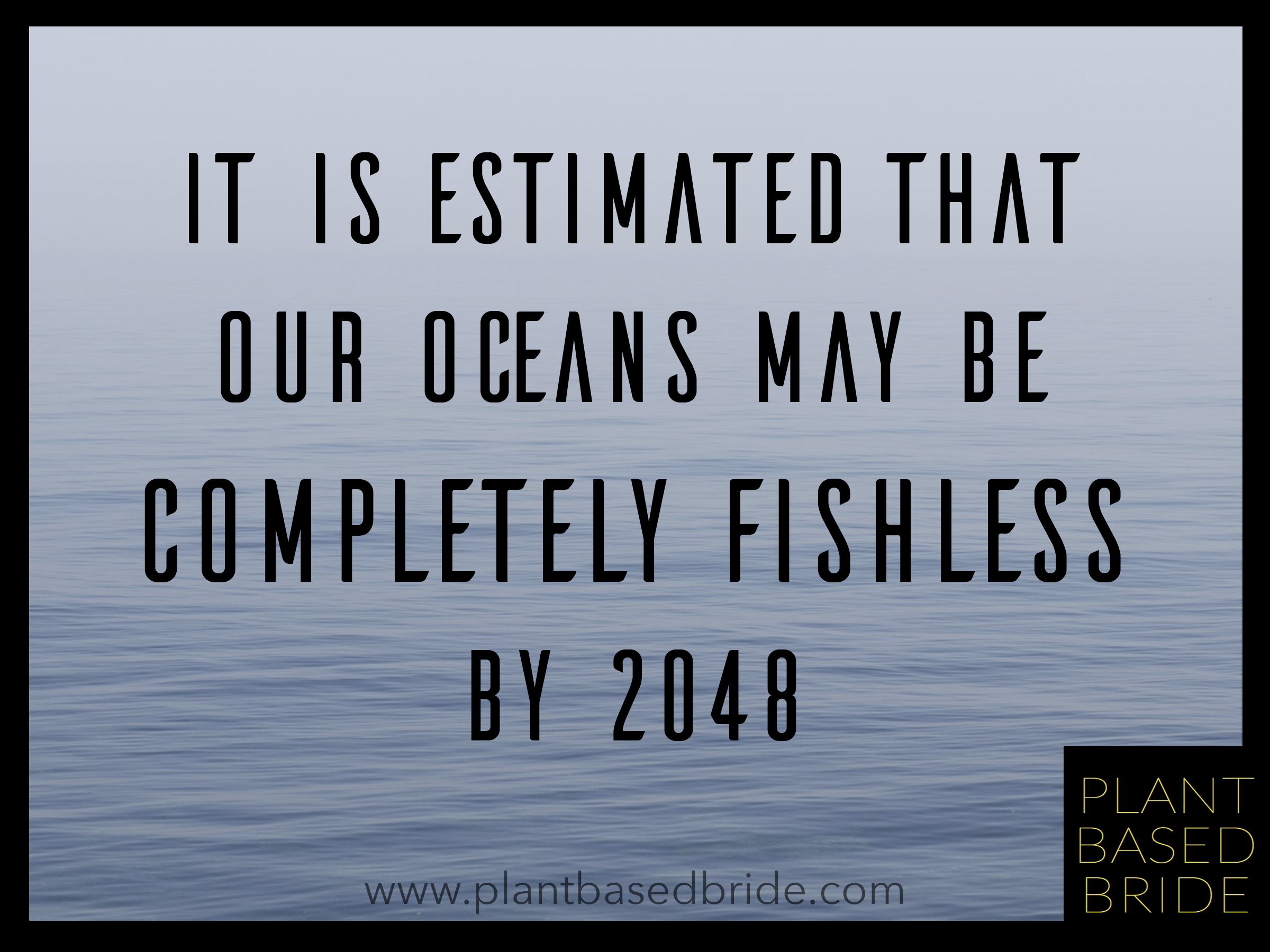
So how come fishing is causing so many non-targeted animals to be killed as by-kill? To understand this, you need to understand how commercial fishing is done.
Long-lines are lines as long as 75 miles covered in hundreds of thousands of baited hooks. While some animals drown or bleed to death in the water, the majority remain alive and struggling until they are reeld into the boat to their slaughter. Each year billions of animals including sharks, sea turtles, birds, and dolphins are injured or killed by long-lines.
Gill Nets ("walls of death") are huge nets ranging in size from 200 feet to more than a mile long which are weighted at the bottom and floated at the top, then left unmonitored for days at a time. The sharp mesh is difficult to see and all but the smallest fish get stuck. If they try to back out the mesh catches them by the gills or fins causing them to suffocate, and if they struggle too violently they will often bleed to death. Any fish who remain alive once on deck are ripped out of the net by hand and suffocate or cut open while still living. Deep sea fish often suffer from decompression, meaning that the change in pressure is so extreme that their stomachs are forced out of their mouths.
Purse Seines are under fire for sometimes catching dolphins in the nets, but are usually intended to catch tuna. Fishers track pods of dolphins, commonly found swimming with tuna, and drop a net to surround the school. The edges of the net are slowly cinched together trapping hundreds of tuna. These fish are almost all conscious when their gills are slit and they are disemboweled.
Bottom trawlers are pretty much what they sound like. These large bag-like nets are dragged across the ocean floor, picking up everything in their path. And by everything, I mean every fish, mammal, stone, and plant. Metal plates on each end weigh down the net and stir up sediment to force fish into it. This method of fishing turns the ocean floor into a clean slate, and not in a good way. Bottom trawling is extremely similar to clear-cutting a forest. These nets can hold hundreds of tons of animals at one time, sometimes crushing them so strongly between each other and the net that their eyes pop out. Fish are dragged along the ocean floor with rocks, coral, and debris for hours, grinding their scales off. Any fish left alive when they are brought to the surface will experience the same agonizing decompression I described earlier.
As you can see, not only is commercial fishing bad for the species we are hoping to catch (those survivors who don't have their gills cut while still alive to bleed to death are put on ice to slowly freeze or suffocate, a process which takes a very long time for cold-blooded animals like fish. It is estimated that it takes up to 15 minutes of intense pain before most fish lose consciousness.) but also for the nearly 1,000 marine mammals who are caught daily as by-catch and thrown back into the water to be killed by swarming birds or bleed to death, if they hadn't already died due to the torture they were subjected to.
Fish and Your Health
As if these environmental reasons weren't enough to discourage anyone from eating fish, it also has numerous ill effects on your health. It is advised that pregnant women and children completely avoid those species of fish that have been found to contain high levels of mercury due to their negative impact on developing nervous systems as well as their accelerating effect on arthrosclerosis (a hardening of the arteries which leads to heart attacks and strokes). Fish also contain PCBs and dioxins which have been linked to cancer and reproductive problems and are a major cause of food-borne illness.
Fish is made up of as much as 60% fat, which contributes to obesity and diabetes. Fish also contains cholesterol, at an even higher proportion of cholesterol per calorie than red meat. Fish contains substantial amounts of animal protein, which as we now know, contributes to bone loss and osteoporosis. In fact, the Inuits (widely known to consume the highest percentage of fish in their diet in the world) have the highest rates of osteoporosis on the planet. It has been found that both male and female Inuits have anywhere from 10-15% higher bone loss than those of Caucasian descent in the United States of the same age. This is despite a consumption of up to 2,500 mg of calcium a day (a majority of which comes from fish bones).
You might also like: Building Strong Bones With Plants and Should You Worry About Your Body's pH?
What about fish oil supplements?
Fish oil supplements cause LDL (the bad cholesterol) to rise in those that take it, even in those supplements which have had the cholesterol removed through purification. It was found in one study that fish oil treatment did not promote favourable changes in atherosclerotic coronary arteries' diameters, even after 2 years. Fish oil has another less than desirable effect: it supresses our immune system. As you know, a suppressed immune system is less able to fight of infections and diseases, including cancer. Fish oil has also been found to cause severe bleeding.
All in all, it's clear to see that not only is choosing to eat fish a choice to diminish our health but a choice to corroborate in the torture and slaughter of billions of intelligent, feeling, animals every single year. Going pescatarian isn't the path towards health, it's the path towards death; for us and our planet's aquatic life. I don't eat fish because I want to live a long, healthy life in which visits to the ocean include marine life sightings, rather than swimming in a glorified pool, devoid of living things. What does eating fish do for you that is so great it outweighs the harm? I think you'll find with a bit of reflection that the answer is: "Nothing."
Until next time,

What are your thoughts on the fishing industry? Join the conversation below and on social media! (Use the hashtag #plantbasedbride so I can find your posts and tag me, @elizabethturn, on instagram and twitter!)
Don't forget to subscribe to the Plant Based Bride newsletter to be notified when new posts are published, get news & updates, and receive a FREE goal setting printable to go along with my 5 Steps for Setting Great Goals blog post!
Further Reading & Sources
http://www.earthsave.org/news/03summer/fish.htm
http://www.consumerreports.org/cro/2012/08/the-benefits-and-risks-of-eating-fish/index.htm
http://www.peta.org/issues/animals-used-for-food/factory-farming/fish/commercial-fishing/



The Ultimate Wedding Planning Timeline!
This week Jason and I celebrated our one year anniversary, which means we're now less than a year away from our wedding! While this makes me incredibly excited (I might have squealed for a second...) it also makes me more than a bit nervous. Only a year until our wedding?? How could we possibly get everything done? What needs to be tackled first? What do I do?? But luckily, being the organized bride-to-be that I am, I'd already compiled a list of tasks to get done before the wedding a couple of weeks after our engagement. Once I'd listed everything that came to mind I headed to Pinterest and searched for "wedding planning timeline". I then proceeded to repin every search result and add anything I'd missed to my list. By the end of a couple of hours I had a pretty comprehensive list, and I realized that other engaged couples may benefit from it! So here it is, the ultimate wedding planning timeline to keep you organized right up until your big day!
This week Jason and I celebrated our one year anniversary, which means we're now less than a year away from our wedding! While this makes me incredibly excited (I might have squealed for a second...) it also makes me more than a bit nervous. Only a year until our wedding?? How could we possibly get everything done? What needs to be tackled first? What do I do?? But luckily, being the organized bride-to-be that I am, I'd already compiled a list of tasks to get done before the wedding a couple of weeks after our engagement. Once I'd listed everything that came to mind I headed to Pinterest and searched for "wedding planning timeline". I then proceeded to repin every search result and add anything I'd missed to my list. By the end of a couple of hours I had a pretty comprehensive list, and I realized that other engaged couples may benefit from it! So here it is, the ultimate wedding planning timeline to keep you organized right up until your big day!
Without further ado, here's the ultimate wedding planning timeline! Pin it to your wedding board on Pinterest to refer to as you plan your big day!
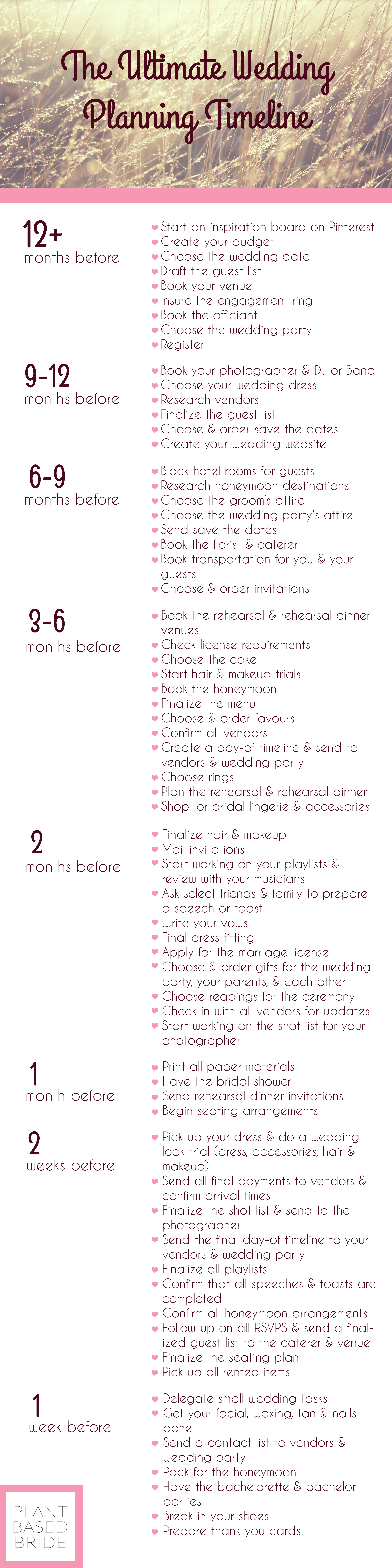

Jason and I have almost completed the 12+ months before checklist. Not bad for two people as busy as we are! If you found this post helpful please share it with your friends and family who are planning their wedding. We've got to help each other out. This process is pretty daunting alone!
Until next time,

Follow me on Pinterest to see all of my wedding pins! I have FOUR dedicated wedding boards!
Head over to my profile to see the other two, Planning the Big Day and The DIY Wedding!
Don't forget to subscribe to the Plant Based Bride newsletter for updates and a FREE goal setting printable! xox





It's almost my birthday, and that means lusting after the slow fashion picks on my Sustainable Wardrobe Pinterest board!These are a few of my favourite things...